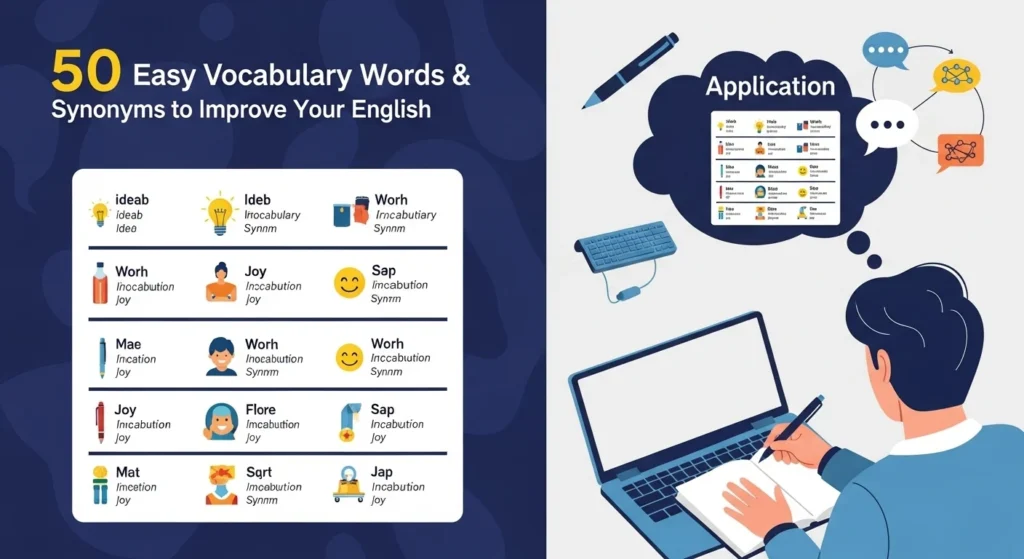
Learning synonyms in sentences is one of the easiest ways to improve your English vocabulary and understand how different words are used in everyday communication. Instead of simply memorizing similar words, seeing them in real sentences helps you understand their meaning, tone, and the situations where they fit best.
Whether you’re a student, writer, job seeker, or English learner, using synonyms in context can make your writing more natural, engaging, and professional. It also helps you avoid repeating the same words, making your content clearer and more enjoyable to read.
1. Happy
Meaning: Feeling good inside.
Examples: She is happy today. The child looks happy.
2. Joyful
Meaning: Full of happiness.
Examples: She feels joyful. The party was joyful.
3. Big
Meaning: Large in size.
Examples: He has a big house. The dog is big.
4. Large
Meaning: More size than normal.
Examples: They live in a large city. She bought a large bag.
5. Small
Meaning: Little in size.
Examples: I have a small pen. The box is small.
6. Little
Meaning: Not much or small.
Examples: Give me little water. She has little time.
7. Fast
Meaning: Very quick.
Examples: The car is fast. He runs fast.
8. Quick
Meaning: Done in a short time.
Examples: Take quick action. She gave a quick reply.
9. Smart
Meaning: Good at thinking.
Examples: He is a smart boy. She looks smart today.
10. Intelligent
Meaning: Very clever.
Examples: He is intelligent. The student is intelligent.
11. Beautiful
Meaning: Very nice looking.
Examples: The flower is beautiful. She is beautiful.
12. Pretty
Meaning: Soft and nice looking.
Examples: She wears a pretty dress. The girl is pretty.
13. Start
Meaning: Begin something.
Examples: Class will start now. Let’s start work.
14. Begin
Meaning: To open or launch.
Examples: School will begin soon. The movie began.
15. Finish
Meaning: Complete work.
Examples: Finish your homework. Work finished early.
16. End
Meaning: Stop something.
Examples: The story will end. Class ended.
17. Easy
Meaning: Not difficult.
Examples: This question is easy. The test was easy.
18. Simple
Meaning: Very clear.
Examples: This is a simple task. Write simple English.
19. Good
Meaning: Nice quality.
Examples: He is a good man. This is good food.
20. Nice
Meaning: Pleasant.
Examples: She is nice. Nice weather today.
21. Bad
Meaning: Not good.
Examples: This is bad work. Bad food hurts health.
22. Poor
Meaning: Low quality.
Examples: He is poor. Poor result came.
23. Talk
Meaning: Speak with someone.
Examples: They talk daily. Let’s talk.
24. Speak
Meaning: Use voice to say.
Examples: He can speak English. She speaks softly.
25. Look
Meaning: Use eyes.
Examples: Look at the sky. She looks happy.
26. See
Meaning: Watch something.
Examples: I see birds. Did you see him?
27. Ask
Meaning: Request information.
Examples: Ask the teacher. He asked a question.
28. Question
Meaning: A sentence asking something.
Examples: Ask a question. Answer the question.
29. Stop
Meaning: Not move.
Examples: Stop the car. Please stop talking.
30. Halt
Meaning: Suddenly stop.
Examples: The bus halted. Work halted.
31. Like
Meaning: Feel good about something.
Examples: I like tea. She likes books.
32. Love
Meaning: Deep like.
Examples: I love my family. She loves music.
33. Enjoy
Meaning: Feel happy doing something.
Examples: Enjoy the trip. They enjoy games.
34. Begin Work
Meaning: Start working.
Examples: He begins work early. Let’s begin work.
35. Finish Work
Meaning: Complete work.
Examples: Finish your task. Work will finish soon.
36. Tell
Meaning: Give information.
Examples: Tell me a story. She tells the truth.
37. Say
Meaning: Speak words.
Examples: Say yes. He said hello.
38. Move
Meaning: Change place.
Examples: Don’t move. The car moved.
39. Run
Meaning: Move fast on your feet.
Examples: He can run fast. The boy runs.
40. Walk
Meaning: Move slowly on the feet.
Examples: She walks daily. Let’s walk.
41. Give
Meaning: Provide something.
Examples: Give me water. He gives help.
42. Take
Meaning: Receive something.
Examples: Take this book. She takes tea.
43. Help
Meaning: Support someone.
Examples: Help me, please. He helps poor people.
44. Work
Meaning: Do job activity.
Examples: He works hard. Work started.
45. Play
Meaning: Do a fun activity.
Examples: Children play. Let’s play football.
46. Stay
Meaning: Live or remain.
Examples: Stay here. She stays home.
47. Live
Meaning: Stay alive.
Examples: He lives here. They live together.
48. Learn
Meaning: Get knowledge.
Examples: Learn English. Students learn fast.
49. Teach
Meaning: Give knowledge.
Examples: She teaches English. The teacher teaches students.
50. Use
Meaning: Take help from something.
Examples: Use a pen. He uses a phone.
Conclusion
Learning how to use synonyms in sentences is one of the most effective ways to improve your writing, enhance your vocabulary, and communicate ideas with greater clarity and style. Instead of repeating the same word throughout a paragraph, incorporating synonyms like “happy” for “joyful,” “big” for “enormous,” or “fast” for “rapid” keeps your sentences fresh, dynamic, and engaging for readers. Using synonyms correctly in sentences also helps convey subtle differences in meaning, allowing you to express exactly the right tone, whether formal, casual, emotional, or professional.
Practicing synonyms in everyday sentences not only strengthens your writing skills but also boosts confidence in spoken communication, making conversations feel more natural and expressive. Understanding how synonyms function within sentences is a valuable tool for avoiding redundancy and maintaining reader interest throughout any piece of writing. It also plays a significant role in that using varied but related terms helps improve search visibility and keyword richness. Ultimately, mastering the art of using synonyms in sentences transforms ordinary writing into something truly compelling, polished, and authentically human, connecting with readers on a deeper and more meaningful level.