Have you ever seen someone change their behavior again and again? One day, they do something well, and the next day they don’t. That is when we use the word inconsistent.
For example, a student studies hard one day, but skips work the next day. You might say, “His study routine is inconsistent.”
The word inconsistent means not steady or not the same all the time. In very simple words, it means “changing again and again.”
Learning synonyms for inconsistent can help a lot. Students can write better essays. And in daily life, you can explain changing behavior more clearly.
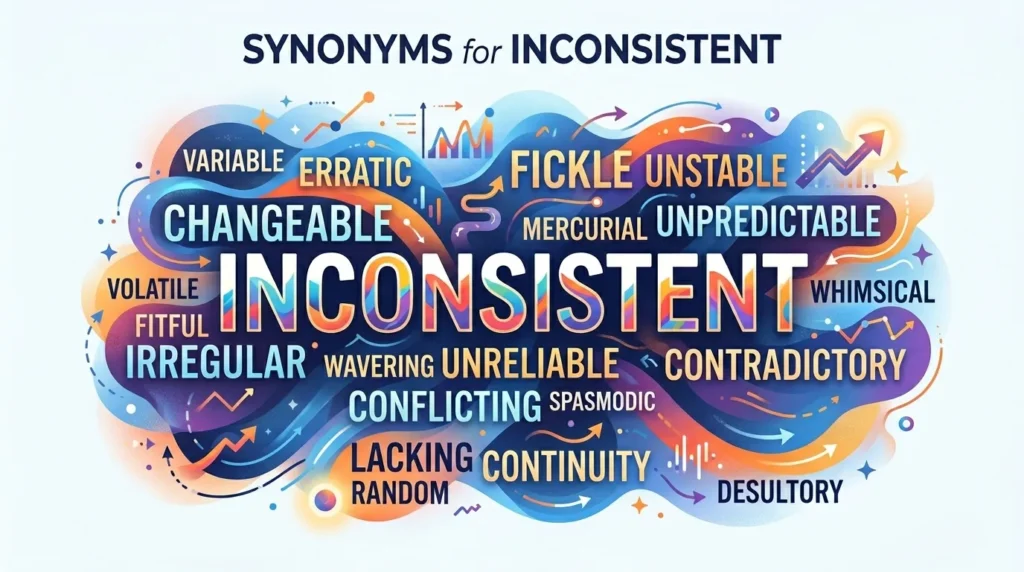
In this guide, you will learn 50 easy synonyms. Each word has a simple meaning and two short examples.
Unstable
Meaning: Not steady or firm.
Examples:
- The table is unstable.
- His mood is unstable.
Erratic
Meaning: Changing in a random way.
Examples:
- His behavior is erratic.
- The signal is erratic.
Irregular
Meaning: Not happening evenly.
Examples:
- She has irregular sleep.
- The pattern is irregular.
Uneven
Meaning: Not smooth or equal.
Examples:
- The road is uneven.
- His work is uneven.
Variable
Meaning: Changing often.
Examples:
- The weather is variable.
- Results are variable.
Fluctuating
Meaning: Going up and down.
Examples:
- Prices are fluctuating.
- His mood is fluctuating.
Unreliable
Meaning: Cannot be trusted to stay the same.
Examples:
- The system is unreliable.
- He is unreliable.
Changeable
Meaning: Easy to change.
Examples:
- The plan is changeable.
- The weather is changeable.
Inconstant
Meaning: Not steady over time.
Examples:
- His love is inconstant.
- The trend is inconstant.
Unpredictable
Meaning: Hard to guess.
Examples:
- The weather is unpredictable.
- He is unpredictable.
Patchy
Meaning: Not even or complete.
Examples:
- The network is patchy.
- His work is patchy.
Spotty
Meaning: Not regular or complete.
Examples:
- The signal is spotty.
- Attendance is spotty.
Fitful
Meaning: Not steady; in short bursts.
Examples:
- He had fitful sleep.
- The progress is fitful.
On-and-off
Meaning: Starting and stopping.
Examples:
- It rains on and off.
- His work is on and off.
Intermittent
Meaning: Not continuous.
Examples:
- The light is intermittent.
- Pain is intermittent.
Random
Meaning: Without pattern.
Examples:
- His choices are random.
- The errors are random.
Disordered
Meaning: Not organized.
Examples:
- The room is disordered.
- His thoughts are disordered.
Chaotic
Meaning: Very messy and confusing.
Examples:
- The place is chaotic.
- His life is chaotic.
Unsteady
Meaning: Not firm or stable.
Examples:
- The ladder is unsteady.
- His voice is unsteady.
Wobbly
Meaning: Moving side to side.
Examples:
- The table is wobbly.
- The bike feels wobbly.
Shaky
Meaning: Not strong or firm.
Examples:
- His hands are shaky.
- The plan is shaky.
Flickering
Meaning: Changing quickly like light.
Examples:
- The light is flickering.
- Hope is flickering.
Uncertain
Meaning: Not sure or clear.
Examples:
- The future is uncertain.
- He feels uncertain.
Doubtful
Meaning: Not sure to happen.
Examples:
- Success is doubtful.
- It looks doubtful.
Incoherent
Meaning: Not clear or logical.
Examples:
- His speech is incoherent.
- The idea is incoherent.
Contradictory
Meaning: Saying opposite things.
Examples:
- His words are contradictory.
- The rules are contradictory.
Conflicting
Meaning: Not agreeing with each other.
Examples:
- The reports are conflicting.
- Their views are conflicting.
Mismatched
Meaning: Not fitting together.
Examples:
- The shoes are mismatched.
- The colors are mismatched.
Out of sync
Meaning: Not matching in time or pattern.
Examples:
- The music is out of sync.
- They are out of sync.
Inharmonious
Meaning: Not in balance or agreement.
Examples:
- The sounds are inharmonious.
- Their relation is inharmonious.
Disjointed
Meaning: Not connected well.
Examples:
- The story is disjointed.
- His speech is disjointed.
Fragmented
Meaning: Broken into parts.
Examples:
- The system is fragmented.
- His ideas are fragmented.
Scattered
Meaning: Spread in different ways.
Examples:
- Papers are scattered.
- His thoughts are scattered.
Unsystematic
Meaning: Not planned or organized.
Examples:
- His work is unsystematic.
- The process is unsystematic.
Haphazard
Meaning: Done without a plan.
Examples:
- The work is haphazard.
- He made haphazard choices.
Disorderly
Meaning: Not neat or ordered.
Examples:
- The room is disorderly.
- His work is disorderly.
Unbalanced
Meaning: Not equal or steady.
Examples:
- The table is unbalanced.
- His life is unbalanced.
Unequal
Meaning: Not even or fair.
Examples:
- The parts are unequal.
- The effort is unequal.
Disproportionate
Meaning: Not in correct balance.
Examples:
- The size is disproportionate.
- The response is disproportionate.
Wayward
Meaning: Hard to control; changing.
Examples:
- The child is wayward.
- His behavior is wayward.
Capricious
Meaning: Changing suddenly.
Examples:
- The weather is capricious.
- He is capricious.
Fickle
Meaning: Changing quickly in liking.
Examples:
- People are fickle.
- His taste is fickle.
Temperamental
Meaning: Mood changes quickly.
Examples:
- She is temperamental.
- The machine is temperamental.
Moody
Meaning: Mood changes often.
Examples:
- He is moody.
- She feels moody.
Volatile
Meaning: Changes quickly and strongly.
Examples:
- The market is volatile.
- His mood is volatile.
Unfixed
Meaning: Not settled or stable.
Examples:
- The plan is unfixed.
- His ideas are unfixed.
Shifting
Meaning: Changing position or state.
Examples:
- The sand is shifting.
- Plans are shifting.
Ever-changing
Meaning: Always changing.
Examples:
- The weather is ever-changing.
- Life is ever-changing.
Up and down
Meaning: Not steady; rising and falling.
Examples:
- His mood is up and down.
- Sales are up and down.
All over the place
Meaning: Not organized or steady.
Examples:
- His work is all over the place.
- Thoughts are all over the place.
Conclusion
Learning synonyms for inconsistent helps you describe change and instability in a clear way. It improves your writing, speaking, and communication skills.
For students and writers, it adds variety and boosts Skills. In daily life, it helps explain behavior, moods, and situations more naturally.
Start using these words in your essays, emails, and conversations. With regular practice, your English will become smoother, clearer, and more confident.