
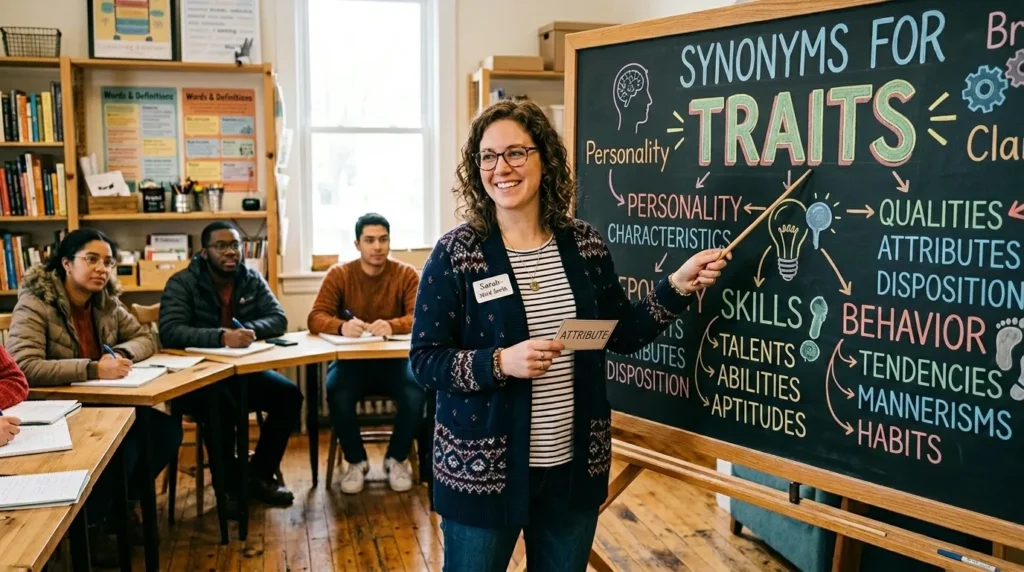
Have you ever tried to describe someone’s personality, and the word “traits” just felt too plain?
Picture this: you are writing a character description for a school essay. Or maybe you are crafting a professional bio for your website. Or perhaps you are simply telling a friend what makes someone special. You write:
“She has many good traits. Her traits make her a great leader. These traits set her apart.”
Repetitive. Flat. Forgettable.
Now try this instead:
“She has many admirable qualities. Her natural attributes make her a great leader. These unique characteristics set her apart.”
Immediately more powerful. That is what the right synonym can do.
Traits are the individual qualities, features, or characteristics that make a person, animal, or thing unique. They describe how someone behaves, thinks, feels, or appears. A person can have creative traits, leadership traits, or even negative traits.
Learning synonyms for traits is essential for students writing personality essays and character analyses. It is a game-changer for bloggers writing about self-improvement and psychology. It helps content writers craft more engaging profiles and descriptions. And in everyday life, it makes you sound more thoughtful and articulate when talking about people.
1. Qualities
Meaning:
- The good or bad features that make a person or thing what they are.
Examples:
- Kindness and patience are two qualities every great teacher must have.
- The job listing asked for candidates with strong leadership qualities.
2. Characteristics
Meaning:
- Specific features or behaviors that define a person, animal, or thing.
Examples:
- One of his most notable characteristics is his ability to stay calm under pressure.
- Scientists study the characteristics of different personality types in their research.
3. Attributes
Meaning:
- Qualities or features that belong to or are associated with a particular person or thing.
Examples:
- Creativity and discipline are key attributes of a successful entrepreneur.
- The recruiter listed honesty as the most important attribute she looks for.
4. Features
Meaning:
- Noticeable or important parts of someone’s personality or appearance.
Examples:
- Her most striking features are her sharp wit and her infectious laugh.
- The article explored the features of a high-performing team culture.
Examples:
- Her most striking features are her sharp wit and infectious laugh.
- The article explored the features that define a high-performing team.
5. Properties
Meaning:
- Specific qualities or characteristics that belong to something or someone.
Examples:
- Resilience is one of the most valued properties of a great athlete.
- The study looked at the psychological properties linked to long-term happiness.
6. Nature
Meaning:
- The basic and essential qualities that define who a person truly is.
Examples:
- It is in his nature to help others before thinking of himself.
- Her calm and patient nature made her the ideal person for the role.
7. Disposition
Meaning:
- A person’s natural tendency to behave or feel in a certain way.
Examples:
- She has a cheerful disposition that makes everyone around her feel at ease.
- His serious disposition made it hard for coworkers to know when he was joking.
8. Temperament
Meaning:
- The natural way a person tends to think, feel, and react emotionally.
Examples:
- Babies with an easy temperament tend to adapt quickly to new routines.
- Her calm temperament made her an excellent negotiator in tough situations.
9. Character
Meaning:
- The combination of mental and moral qualities that defines a person deeply.
Examples:
- True character is revealed not in good times but in moments of real difficulty.
- Building character in young students is just as important as teaching academics.
10. Personality
Meaning:
- The full set of emotional and behavioral traits that make someone unique.
Examples:
- Her bubbly personality made her the most popular person in every room.
- Personality assessments help companies match candidates to the right roles.
11. Tendencies
Meaning:
- Natural habits or inclinations that a person shows regularly over time.
Examples:
- He has a tendency to overthink decisions, which sometimes slows him down.
- Introverted tendencies do not mean a person is shy just inwardly focused.
12. Inclinations
Meaning:
- Natural leanings toward certain behaviors, interests, or ways of thinking.
Examples:
- Her creative inclinations were obvious from the time she was very young.
- His inclinations toward logic and order made him an exceptional engineer.
13. Virtues
Meaning:
- Positive moral traits or qualities that are considered good and admirable.
Examples:
- Honesty, courage, and compassion are virtues taught in many great traditions.
- The mentor valued virtues over skills when choosing who to guide and support.
14. Mannerisms
Meaning:
- Small, distinctive habits or ways of behaving that are unique to a person.
Examples:
- His mannerisms like tapping his pen while thinking, were familiar to everyone.
- Good writers capture a character’s mannerisms to make them feel truly alive.
15. Quirks
Meaning:
- Unusual or odd personal traits that make someone different and interesting.
Examples:
- One of her endearing quirks is arranging her bookshelf by color, not by author.
- Every great character in fiction has at least one memorable quirk to their personality.
16. Hallmarks
Meaning:
- Distinctive traits that identify or define someone or something clearly.
Examples:
- Precision and attention to detail are hallmarks of a skilled surgeon.
- Generosity has always been a hallmark of her personality since childhood.
17. Marks
Meaning:
- Defining signs or features that set someone apart from others.
Examples:
- Humility is one of the marks of a truly great and confident leader.
- The marks of an experienced traveler include flexibility and calm adaptability.
18. Peculiarities
Meaning:
- Unusual personal traits or habits that are specific and unique to someone.
Examples:
- His peculiarities, like reading only at midnight, were known to all his friends.
- Every person has their own peculiarities that make them one of a kind.
19. Idiosyncrasies
Meaning:
- Highly personal and distinctive traits or habits that set someone apart.
Examples:
- Her idiosyncrasies, like humming while she works, became a comfort to her team.
- Great actors study the idiosyncrasies of real people to build believable roles.
20. Strengths
Meaning:
- Positive traits that give a person power, skill, or a natural advantage.
Examples:
- Her greatest strengths are her empathy and her ability to listen deeply.
- Knowing your own strengths is the first step toward building real confidence.
21. Weaknesses
Meaning:
- Traits that limit a person’s effectiveness or cause them difficulty.
Examples:
- Procrastination is a weakness many high-achieving people quietly struggle with.
- Acknowledging your weaknesses honestly is a sign of real self-awareness.
22. Instincts
Meaning:
- Natural, inborn traits or reactions that guide a person without thinking.
Examples:
- Her maternal instincts kicked in the moment she held her newborn baby.
- Good leaders often act on instincts that they cannot always explain in words.
23. Propensities
Meaning:
- Natural tendencies or leanings toward particular behaviors or actions.
Examples:
- He has a propensity for taking risks that has paid off more than once.
- A propensity for kindness is something that can be nurtured from a young age.
24. Predispositions
Meaning:
- Natural tendencies or traits that make someone likely to behave a certain way.
Examples:
- A genetic predisposition to anxiety does not mean it cannot be managed well.
- Her predisposition toward optimism helped her recover from setbacks quickly.
25. Facets
Meaning:
- Individual aspects or sides of a person’s character or personality.
Examples:
- Empathy is just one facet of what makes her such a great counselor.
- The documentary explored every facet of the athlete’s complex personality.
26. Dimensions
Meaning:
- The depth and layers of a person’s character that go beyond the surface.
Examples:
- The biography revealed new dimensions of the leader’s complex inner life.
- Great literature explores the many dimensions of human nature and behavior.
27. Essence
Meaning:
- The most fundamental and defining trait at the core of who someone is.
Examples:
- Kindness is at the very essence of everything she does in life and work.
- The film captured the essence of the historical figure beautifully and honestly.
28. Fiber
Meaning:
- The deep moral traits and inner strength that define a person’s true character.
Examples:
- It takes a person of strong moral fiber to stand up against peer pressure.
- The hardship they endured revealed the true fiber of each team member.
29. Constitution
Meaning:
- The natural makeup or character of a person, physical or psychological.
Examples:
- He has the constitution of a natural leader, calm, decisive, and always fair.
- Her strong emotional constitution helped her survive an incredibly difficult year.
30. Profile
Meaning:
- A set of traits that together create a picture of who a person is.
Examples:
- Her psychological profile pointed to high creativity and strong analytical thinking.
- The hiring team built a profile of the ideal candidate before starting interviews.
31. Make-Up
Meaning:
- The combination of traits and qualities that form a person’s inner character.
Examples:
- Stubbornness and passion are both part of his emotional make-up.
- Understanding a child’s emotional make-up helps teachers support them better.
32. Habits
Meaning:
- Repeated behaviors or tendencies that become part of a person’s character.
Examples:
- Daily reading is a habit that sets high achievers apart from the rest.
- Bad habits are hard to break, but powerful habits are even harder to stop.
33. Gifts
Meaning:
- Natural talents or positive traits that a person is born with or develops early.
Examples:
- Her gift for storytelling was clear from the time she was six years old.
- Not everyone recognizes their own gifts until someone else points them out.
34. Tendencies
Meaning:
- Repeated patterns of behavior that reflect deeper personality traits.
Examples:
- His competitive tendencies pushed him to always improve his personal best.
- Understanding your emotional tendencies helps you communicate far more clearly.
35. Signals
Meaning:
- Behavioral traits that show or hint at deeper personal qualities.
Examples:
- Eye contact and open body language are signals of genuine confidence.
- Early signals of leadership often appear in childhood group activities and play.
36. Indicators
Meaning:
- Traits or behaviors that point toward a deeper quality or condition.
Examples:
- Punctuality and preparation are strong indicators of professional reliability.
- Researchers use behavioral indicators to study personality types scientifically.
37. Elements
Meaning:
- Individual parts of a person’s character that together form the whole.
Examples:
- Trust and transparency are essential elements of a healthy friendship.
- The coach identified key elements of the player’s mental game to strengthen.
38. Components
Meaning:
- Distinct parts of a person’s personality that make up the overall character.
Examples:
- Self-awareness and empathy are core components of emotional intelligence.
- The therapist explored each component of her client’s personality carefully.
39. Signatures
Meaning:
- Distinctive traits or patterns that are uniquely and recognizably someone’s own.
Examples:
- His warm humor is a personal signature that everyone who meets him remembers.
- Generosity became a signature trait of her brand and public identity over time.
40. Values
Meaning:
- Core beliefs and traits that guide how a person lives and makes decisions.
Examples:
- Integrity and fairness are the values that guide every decision she makes.
- A company’s values should reflect the genuine traits of the people who lead it.
41. Imprints
Meaning:
- Deep, lasting traits or patterns left by experience, upbringing, or nature.
Examples:
- Childhood experiences leave lasting imprints on how we relate to other people.
- His time in the military left a strong imprint of discipline on his character.
42. Patterns
Meaning:
- Repeated traits or behaviors that form a recognizable part of a personality.
Examples:
- Avoidance patterns in conflict are a common trait among introverted people.
- Therapists help clients identify unhealthy patterns in their emotional behavior.
43. Nuances
Meaning:
- Subtle traits or fine differences in someone’s character or behavior.
Examples:
- The author captured the nuances of grief through small, precise details.
- Great leaders understand the nuances of every team member’s working style.
44. Expressions
Meaning:
- Ways in which inner traits or emotions are shown outwardly in behavior.
Examples:
- Generosity can be an expression of both confidence and deep compassion.
- Artistic expression is one of the most honest ways to reveal personality traits.
45. Contours
Meaning:
- The shape and outline of a person’s character are its edges and defining lines.
Examples:
- The memoir traced the contours of a deeply complex and fascinating personality.
- Over the years, the contours of his character became more defined and grounded.
46. Complexion
Meaning:
- The overall tone or general character of someone’s personality or behavior.
Examples:
- The moral complexion of the leader influenced the entire culture of the team.
- His cheerful complexion brightened every meeting he walked into.
47. Bent
Meaning:
- A natural inclination or strong leaning toward a particular trait or interest.
Examples:
- She had a natural bent for numbers that made accounting feel effortless.
- His artistic bent was obvious in everything from his clothes to his workspace.
48. Grain
Meaning:
- The deep, natural texture of a person’s character is what they are made of inside.
Examples:
- Dishonesty simply goes against the grain of who she is as a person.
- His integrity runs so deep it is woven into the very grain of his personality.
49. Stamp
Meaning:
- A distinctive personal trait that leaves a clear mark on how someone is seen.
Examples:
- Her creativity left a stamp on every project she ever touched at the company.
- His stamp of quiet confidence was recognized and respected by everyone he met.
50. Makeup
Meaning:
- The complete mix of traits, qualities, and tendencies that form a whole person.
Examples:
- Her emotional makeup allows her to connect deeply with people in pain.
- Understanding a person’s mental makeup takes time, empathy, and real patience.
Conclusion
Expanding your vocabulary around synonyms for traits transforms the way you describe people, characters, and personalities. It makes your essays richer, your blogs more insightful, and your everyday conversations more precise. Whether you are writing a character profile, a personal statement, a leadership article, or a simple text message, the right word paints the truest picture. Start today. Choose three new words from this list. Use them. Own them. And watch your language grow stronger with every sentence you write.