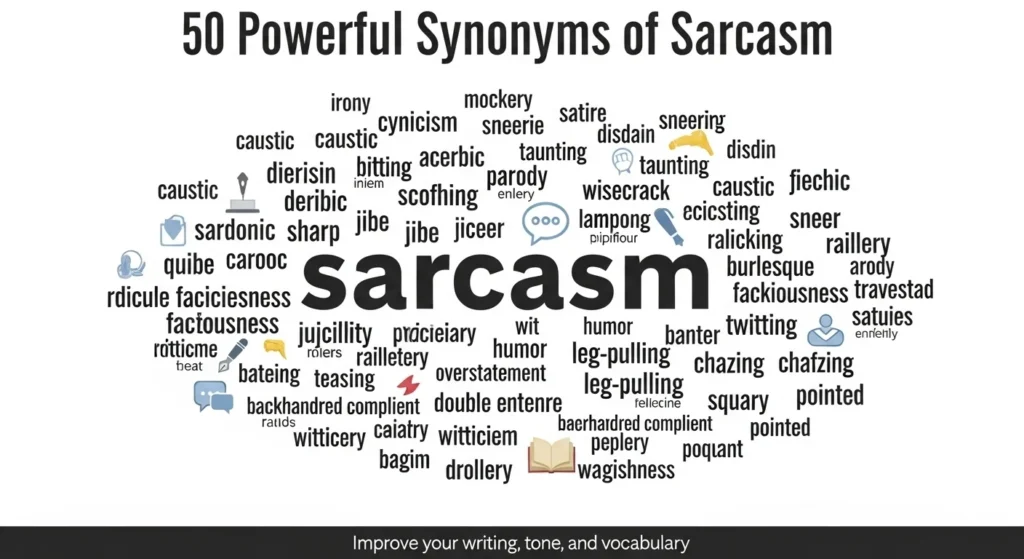
Learning the synonyms of sarcasm can help you understand and use this expressive word in different situations. Sarcasm is a form of speech that uses irony or mocking words to show humor, criticism, or annoyance. Choosing the right synonym makes your writing more interesting, accurate, and easier for readers to understand.
Synonyms of sarcasm will improve your vocabulary and help you avoid repeating the same word. Some synonyms are best for casual conversations, while others are more suitable for formal writing, literature, or professional communication.
In this Article, you’ll explore the most useful synonyms of sarcasm, along with their simple meanings and practical examples. By the end, you’ll know how to use each synonym correctly, making your writing clearer, more engaging, and more effective in every context
Irony
Meaning: Saying something but meaning the opposite.
Examples:
- He said it with irony.
- That comment was pure irony.
Mockery
Meaning: Making fun of someone.
Examples:
- His words felt like mockery.
- She laughed in mockery.
Ridicule
Meaning: Making someone look silly.
Examples:
- He faced ridicule at school.
- The joke was full of ridicule.
Satire
Meaning: Humor used to criticize.
Examples:
- The show uses satire.
- He writes satire about politics.
Sneer
Meaning: A mean smile or comment.
Examples:
- She spoke with a sneer.
- His sneer hurt her feelings.
Taunt
Meaning: Words used to tease in a hurtful way.
Examples:
- He made a taunt.
- She ignored the taunts.
Jibe
Meaning: A rude joke.
Examples:
- He made a quick jibe.
- Her jibe was sharp.
Gibe
Meaning: A sarcastic remark.
Examples:
- He threw a gibe at her.
- She answered his gibe calmly.
Snark
Meaning: Sharp and sarcastic humor.
Examples:
- The article had snark.
- He replied with snark.
Wit
Meaning: Smart and funny speech.
Examples:
- She has quick wit.
- His wit made us laugh.
Dry Humor
Meaning: Funny words said thoughtfully.
Examples:
- He uses dry humor.
- Her dry humor is clever.
Cutting Remark
Meaning: A hurtful comment.
Examples:
- That was a cutting remark.
- She made a cutting remark.
Bitter Humor
Meaning: Funny but sad or harsh words.
Examples:
- He used bitter humor.
- The joke had bitter humor.
Cynicism
Meaning: A doubtful and negative tone.
Examples:
- His voice showed cynicism.
- She spoke with cynicism.
Sardonic Comment
Meaning: Cold and mocking speech.
Examples:
- He gave a sardonic comment.
- Her sardonic comment shocked us.
Smart Remark
Meaning: A sharp and quick reply.
Examples:
- He made a smart remark.
- She ignored his smart remark.
Barbed Comment
Meaning: A comment meant to hurt.
Examples:
- That was a barbed comment.
- She made barbed comments.
Derision
Meaning: Showing strong dislike through mockery.
Examples:
- He spoke with derision.
- They laughed in derision.
Scoff
Meaning: To speak with disrespect.
Examples:
- He scoffed at the idea.
- She scoffed loudly.
Teasing
Meaning: Playfully making fun.
Examples:
- It was just teasing.
- He smiled while teasing.
Sharp Tongue
Meaning: Speaking harshly.
Examples:
- She has a sharp tongue.
- His sharp tongue hurt others.
Dry Comment
Meaning: A quiet sarcastic remark.
Examples:
- He made a dry comment.
- Her dry comment was funny.
Snide Remark
Meaning: A mean and indirect insult.
Examples:
- She made a snide remark.
- He ignored the snide remark.
Banter
Meaning: Playful teasing talk.
Examples:
- They enjoy friendly banter.
- The banter made us laugh.
Wisecrack
Meaning: A clever, funny comment.
Examples:
- He made a wisecrack.
- Her wisecrack was quick.
Quip
Meaning: A short funny comment.
Examples:
- He made a funny quip.
- Her quip surprised us.
Put-down
Meaning: An insult.
Examples:
- That was a put-down.
- He used a harsh put-down.
Dig
Meaning: A small insult.
Examples:
- He made a dig at me.
- She took a dig at him.
Backhanded Compliment
Meaning: A fake compliment.
Examples:
- That was a backhanded compliment.
- She gave him a backhanded compliment.
Caustic Humor
Meaning: Very sharp and hurtful humor.
Examples:
- He uses caustic humor.
- Her caustic humor is strong.
Ironic Tone
Meaning: Voice that shows the opposite meaning.
Examples:
- She used an ironic tone.
- His ironic tone was clear.
Mocking Tone
Meaning: Voice that makes fun of someone.
Examples:
- He spoke in a mocking tone.
- Her mocking tone hurt him.
Smirk
Meaning: A small mocking smile.
Examples:
- He smirked.
- She noticed his smirk.
Sarcastic Humor
Meaning: Humor that mocks someone.
Examples:
- He enjoys sarcastic humor.
- Her sarcastic humor is sharp.
Wry Humor
Meaning: Dry and slightly sarcastic humor.
Examples:
- He showed wry humor.
- Her wry humor is subtle.
Snicker
Meaning: A quiet laugh at someone.
Examples:
- He gave a snicker.
- She heard them snicker.
Mocking Laugh
Meaning: A laugh that makes fun.
Examples:
- He gave a mocking laugh.
- She heard a mocking laugh.
Dry Wit
Meaning: Serious face but funny words.
Examples:
- He has dry wit.
- Her dry wit is clever.
Sharp Humor
Meaning: Humor that can hurt.
Examples:
- He uses sharp humor.
- Her sharp humor shocked us.
Critical Humor
Meaning: Funny words used to criticize.
Examples:
- The show has critical humor.
- He writes critical humor.
Tongue-in-cheek
Meaning: Not serious, slightly sarcastic.
Examples:
- He spoke tongue-in-cheek.
- Her comment was tongue-in-cheek.
Rude Joke
Meaning: A joke that can hurt feelings.
Examples:
- That was a rude joke.
- He made a rude joke.
Insult
Meaning: Words that hurt someone.
Examples:
- That felt like an insult.
- He threw an insult.
Mocking Words
Meaning: Words used to make fun.
Examples:
- She used mocking words.
- His mocking words hurt.
Harsh Comment
Meaning: A strong and hurtful remark.
Examples:
- That was a harsh comment.
- She made a harsh comment.
Bitter Remark
Meaning: A comment full of anger.
Examples:
- He made a bitter remark.
- Her bitter remark surprised us.
Contempt
Meaning: Strong dislike shown in words.
Examples:
- He spoke with contempt.
- Her voice showed contempt.
Scorn
Meaning: Feeling of strong disrespect.
Examples:
- She looked at him with scorn.
- His words were full of scorn.
Derisive Comment
Meaning: A comment that shows ridicule.
Examples:
- He made a derisive comment.
- She ignored the derisive comment.
Flippant Remark
Meaning: A careless, sarcastic comment.
Examples:
- He made a flippant remark.
- Her flippant remark was rude.
Conclusion
In conclusion, sarcasm is a unique form of expression that adds wit, humor, and sometimes bite to our communication. By exploring synonyms like irony, mockery, satire, derision, and ridicule, we gain a deeper appreciation for the subtle differences between playful teasing and sharper, more cutting remarks.
Whether you’re writing dialogue for a story, crafting witty social media content, or simply trying to describe someone’s tone more accurately, having a varied vocabulary around “sarcasm” helps you capture the exact flavor of the remark, be it lighthearted, dry, or biting.
Not every sarcastic comment carries the same intent, and choosing the right synonym allows you to reflect that nuance clearly.
Ultimately, sarcasm remains one of the most versatile tools in language, capable of conveying humor, criticism, or frustration depending on how it’s delivered. By understanding its synonyms, you can better identify and use this clever form of expression in both writing and everyday conversation.
.