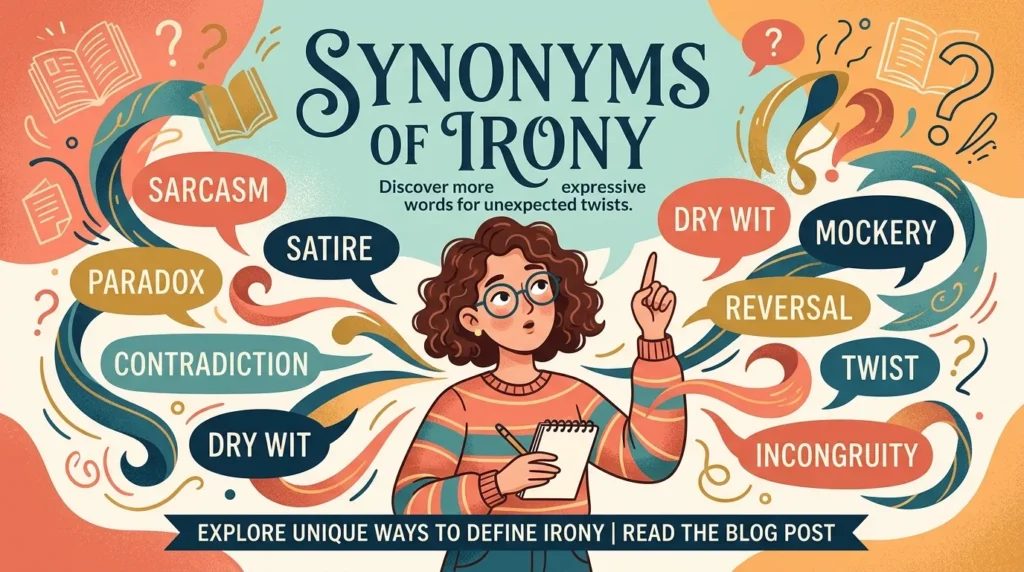
Have you ever said “Oh, great!” when something went terribly wrong? That’s irony in action. It’s one of the most powerful tools in the English language, and it shows up everywhere, from Shakespeare to social media.
The synonyms of irony help you say the same thing in fresh, powerful ways. Irony simply means saying one thing but meaning another, or when life turns out the opposite of what you expected.
For students, knowing these words boosts essay scores. Personality and depth. For daily English users, they make conversations more colorful and real. Whether you’re writing a caption, a school paper, or a professional email, mastering the synonyms of irony makes you sound sharper and smarter.
1. Sarcasm
Meaning:
- Sarcasm is when you say the opposite of what you mean, usually to mock or tease someone.
Examples:
- “Oh sure, because everything always goes perfectly for me,” she said after missing her bus again.
- He looked at the burnt toast and said, “Wow, a masterpiece for breakfast.”
2. Paradox
Meaning:
- A paradox is a statement that seems wrong but actually makes sense when you think about it.
Examples:
- “The more you try to forget, the more you remember.” That’s a perfect paradox.
- The teacher said, “You have to break the rules to truly understand them.”
3. Satire
Meaning:
- Satire uses humor or irony to criticize something, like politics or society.
Examples:
- The cartoon used satire to make fun of how politicians never keep their promises.
- The comedy show used satire to highlight how wasteful big corporations can be.
4. Wit
Meaning:
- Wit is quick, clever humor that makes people laugh and think at the same time.
Examples:
- His wit shone through when he said, “I’m not lazy, I’m just energy efficient.”
- She used sharp wit to turn every awkward moment into laughter.
5. Mockery
Meaning:
- Mockery means making fun of someone or something disrespectfully or ironically.
Examples:
- The students made a mockery of the overly long homework assignment by calling it “a short story.”
- His mockery of the situation helped ease the tension in the room.
6. Cynicism
Meaning:
- Cynicism is the belief that people are mostly selfish or that things will always go wrong.
Examples:
- Her cynicism grew after three job interviews ended with the same silence.
- “People only help when there’s something in it for them,” he said with a shrug of cynicism.
7. Contradiction
Meaning:
- A contradiction is when two ideas or actions directly oppose each other.
Examples:
- He said he hated social media and posted about it three times that day.
- The sign said “Quiet Zone” right next to a construction site, a perfect contradiction.
8. Incongruity
Meaning:
- Incongruity means when two things don’t match or seem out of place together.
Examples:
- There was an obvious incongruity between his fancy suit and muddy boots.
- The incongruity of a life coach with a messy office made everyone chuckle.
9. Absurdity
Meaning:
- Absurdity means something so silly or unreasonable that it becomes funny or ironic.
Examples:
- The absurdity of standing in a two-hour queue for a five-minute ride was not lost on anyone.
- She laughed at the absurdity of her cat knocking the water glass off the table again.
10. Humor
Meaning:
- Humor is the ability to find something funny, often by pointing out life’s little ironies.
Examples:
- His humor about missing deadlines made his boss laugh instead of frown.
- She used gentle humor to point out the irony of a dentist eating candy.
11. Ridicule
Meaning:
- Ridicule means making someone or something look foolish through irony or mockery.
Examples:
- The comedian used ridicule to expose the gap between what politicians say and what they do.
- He held back from ridicule, knowing the situation was already embarrassing enough.
12. Farce
Meaning:
- A farce is an event or situation that is so badly managed that it becomes completely ridiculous.
Examples:
- The “organized” school event turned into a total farce when the speakers arrived two hours late.
- Watching the meeting collapse over a Wi-Fi password was a complete farce.
13. Burlesque
Meaning:
- Burlesque is an exaggerated, comic imitation of something serious, used to show its absurdity.
Examples:
- The play was a burlesque of political debates, with candidates arguing over their sandwich orders.
- She performed a burlesque of a boardroom meeting that had the whole office laughing.
14. Parody
Meaning:
- A parody is a funny copy of something like a song, film, or speech that highlights its irony.
Examples:
- The YouTube channel made a brilliant parody of motivational speakers who say nothing helpful.
- His parody of action movie heroes pointed out how unrealistic they really are.
15. Travesty
Meaning:
- A travesty is a very poor or distorted version of something that should be better.
Examples:
- Calling that a gourmet meal was a travesty it was just microwaved noodles.
- The rushed trial was described as a travesty of justice.
16. Caricature
Meaning:
- A caricature is an exaggerated image or description that highlights someone’s quirks ironically.
Examples:
- The cartoon drew the politician as a caricature with an enormous nose and tiny hands.
- By the third chapter, the villain had become a caricature of pure evil rather than a real character.
17. Derision
Meaning:
- Derision is strong, contemptuous mockery directed at someone or something.
Examples:
- His suggestion was met with derision by those who had heard it fail before.
- She ignored the derision and calmly proved everyone wrong.
18. Banter
Meaning:
- Banter is playful, back-and-forth teasing between friends, often using ironic remarks.
Examples:
- Their morning banter always involved pretending they both hated coffee while sipping it nonstop.
- The banter between the two coworkers made the whole office feel relaxed.
19. Wordplay
Meaning:
- Wordplay is the clever use of language, like puns, where the double meaning creates irony or humor.
Examples:
- His email sign-off, “Rest assured,” was a classic piece of wordplay after a chaotic project.
- She loved wordplay so much that her text messages read like riddles.
20. Double Entendre
Meaning:
- A double entendre is a phrase with two meanings, one innocent, one ironic or cheeky.
Examples:
- The advertising slogan was full of double entendre that adults caught, and children missed.
- He winked after the double entendre in his speech, and the crowd burst out laughing.
21. Understatement
Meaning:
- An understatement describes something as far less serious or impressive than it really is.
Examples:
- Saying “the flood was a bit of a problem” was quite the understatement.
- She called winning the championship “not too bad” a classic understatement.
22. Overstatement
Meaning:
- An overstatement makes something sound far bigger or more dramatic than it actually is.
Examples:
- “I’ve told you a million times to close the door!” is a common overstatement.
- His review, calling the tiny café “the greatest culinary destination on Earth,” was a funny overstatement.
23. Hyperbole
Meaning:
- Hyperbole is extreme exaggeration used for effect, often creating irony through its excess.
Examples:
- “I’m so hungry I could eat a horse” is a hyperbole everyone uses and no one believes.
- She used hyperbole freely, claiming she “waited an eternity” for the elevator.
24. Ambiguity
Meaning:
- Ambiguity is when something can be understood in more than one way, creating irony or confusion.
Examples:
- His thank-you note was full of ambiguity no one was sure if he was grateful or annoyed.
- The job listing’s use of “competitive salary” was pure ambiguity at its finest.
25. Innuendo
Meaning:
- An innuendo is a subtle hint or suggestion, often ironic or slightly mocking.
Examples:
- Her comment about his “interesting” presentation style was an innuendo for “boring.”
- The review used innuendo to say the service was slow without ever using that word.
26. Quip
Meaning:
- A quip is a short, clever, ironic remark that makes people laugh or think.
Examples:
- “I work best under pressure or not at all,” was his quip during the interview.
- She always had a quip ready for any awkward silence at the dinner table.
27. Jest
Meaning:
- A jest is something said or done as a joke, often using irony to be funny.
Examples:
- He said it in jest, but his boss took the resignation letter seriously.
- Her jest about “loving Mondays” always got the biggest groan in the room.
28. Wryness
Meaning:
- Wryness is a dry, slightly twisted sense of irony amused but not quite smiling.
Examples:
- There was a certain wryness in how he described losing his umbrella in the one rainstorm of the year.
- Her wryness came through when she called the traffic jam “a lovely outdoor meditation.”
29. Dry Humor
Meaning:
- Dry humor is irony delivered in a flat, serious tone, making it even funnier.
Examples:
- His dry humor was so deadpan that newcomers never knew if he was joking.
- She used dry humor to describe the chaos with zero change in expression.
30. Black Humor
Meaning:
- Black humor finds comedy in dark, uncomfortable, or tragic situations.
Examples:
- The hospital staff used black humor to cope with a particularly stressful week.
- His black humor about deadlines made the tension in the office slightly bearable.
31. Whimsy
Meaning:
- Whimsy is playful, light irony charming and imaginative rather than harsh.
Examples:
- Her blog post about “adulting” was full of whimsy that made readers feel seen.
- The shop’s sign read “Open When We Feel Like It,” a touch of whimsy that everyone loved.
32. Twist
Meaning:
- A twist is an unexpected turn of events that delivers a surprising, ironic outcome.
Examples:
- The story’s twist that the detective was the thief shocked every reader.
- Life loves a twist: he quit his job to travel and then got hired abroad.
33. Reversal
Meaning:
- A reversal is when something turns out to be the complete opposite of what was expected.
Examples:
- The reversal was stunning the team that was losing at halftime won by ten goals.
- In a reversal of roles, the student ended up teaching the teacher something new.
34. Discrepancy
Meaning:
- A discrepancy is a clear difference between two things that should match but don’t.
Examples:
- There was a huge discrepancy between how the hotel looked online and in real life.
- The discrepancy between his words and actions spoke louder than anything else.
35. Incongruousness
Meaning:
- Incongruousness means being out of place or not fitting, creating an ironic effect.
Examples:
- The incongruousness of a wedding held at a pizza parlor made it unforgettable.
- Her perfectly ironed suit in the muddy garden showed a clear incongruity.
36. Contrariness
Meaning:
- Contrariness is the tendency to do or say the opposite of what’s expected, often for ironic effect.
Examples:
- His contrariness was legendary he always loved what others hated.
- She wore a winter coat in July out of pure contrariness, and somehow made it work.
37. Duality
Meaning:
- Duality is the quality of having two opposite natures at the same time, creating irony.
Examples:
- The film explored the duality of a man who was both a thief and a hero.
- There’s a duality in social media: it connects us while making us feel more alone.
38. Insinuation
Meaning:
- An insinuation is an indirect, often ironic suggestion that implies something negative.
Examples:
- Her insinuation that the project “must have been easy” felt like a clear insult.
- He heard the insinuation behind her smile and decided to ignore it.
39. Implication
Meaning:
- An implication is something suggested but not stated directly, often with ironic undertones.
Examples:
- The implication of his “interesting” comment was clear he hated the design.
- She caught the implication immediately and smiled to herself.
40. Subtext
Meaning:
- Subtext is the hidden meaning beneath what is actually said a layer of irony below the surface.
Examples:
- The whole conversation had a subtext: neither of them wanted to admit the plan had failed.
- A good writer hides subtext between the lines so readers discover it slowly.
41. Allegory
Meaning:
- An allegory is a story with a hidden meaning that comments ironically on real life.
Examples:
- Animal Farm is a famous allegory that uses farm animals to mock political systems.
- He told a simple allegory about a broken clock to explain how institutions fail.
42. Allusion
Meaning:
- An allusion is an indirect reference to something well-known, often used ironically.
Examples:
- Calling the messy office “quite the Garden of Eden” was a sarcastic allusion.
- Her allusion to Romeo and Juliet showed how doomed the project really was.
43. Acrimony
Meaning:
- Acrimony is sharp, bitter irony with an angry or harsh edge.
Examples:
- The resignation letter was full of acrimony disguised as polite language.
- Years of broken promises had left an acrimony in her tone that no smile could hide.
44. Levity
Meaning:
- Levity is light, ironic humor used to make a serious or heavy situation feel less tense.
Examples:
- His joke added levity to a very difficult team meeting.
- A little levity goes a long way when delivering bad news.
45. Antiphrasis
Meaning:
- Antiphrasis is the use of a word with the opposite meaning of its literal definition for ironic effect.
Examples:
- Calling a huge man “Tiny” is a classic case of antiphrasis.
- Naming a tiny dog “Goliath” is antiphrasis at its most fun.
46. Sophistry
Meaning:
- Sophistry is clever but misleading reasoning that sounds right but actually contradicts itself.
Examples:
- His argument was pure sophistry, impressive on the surface but hollow underneath.
- The ad used sophistry to make the expensive product seem like a money-saving deal.
47. Bathos
Meaning:
- Bathos is an ironic drop from something grand or serious to something trivial and silly.
Examples:
- The speech about world peace ended with a reminder to refill the coffee machine pure bathos.
- The heroic rescue story fell into bathos when the cat jumped back out the window.
48. Irrationality
Meaning:
- Irrationality is when something is so logically backward that it creates an ironic effect.
Examples:
- The irrationality of paying more for a smaller package wasn’t lost on the shoppers.
- There’s an obvious irrationality in banning books to promote free thinking.
49. Circumlocution
Meaning:
- Circumlocution is using many words to avoid saying something directly, often creating ironic distance.
Examples:
- Instead of saying “you’re fired,” the manager used circumlocution: “We’re exploring a restructured team dynamic.”
- His circumlocution about being “otherwise engaged” meant he simply forgot to show up.
50. Juxtaposition
Meaning:
- Juxtaposition places two contrasting ideas side by side to highlight their ironic difference.
Examples:
- The photo used juxtaposition: a gleaming new car parked in front of a crumbling house.
- The poem’s juxtaposition of war and flowers made the irony impossible to miss.
Conclusion
Learning the synonyms of irony is one of the smartest moves you can make as a writer, speaker, or student. These words sharpen your essays, energize your blogs, and make your daily conversations more alive. A richer vocabulary means you’re never stuck using the same word twice. Start small, drop one new synonym into your next email, your next post, or your next chat. Practice makes your language grow. The more you use these words, the more naturally they’ll flow.