
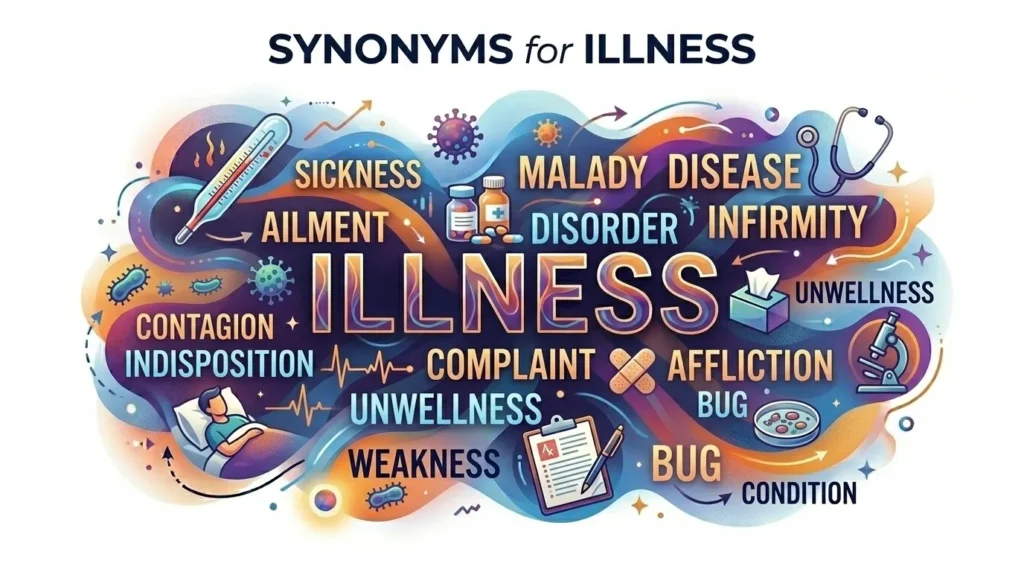
Have you ever felt weak, tired, or not well and told someone, “I have an illness”? We often use the word illness when talking about health problems.
For example, if someone has a fever or a cold, we say they are suffering from an illness.
The word illness means a state of being sick or not healthy. In very simple words, it means “being unwell.”
Learning synonyms for illness is very useful. Students can write better essays. And in daily life, you can talk about health in a clearer and more natural way.
In this guide, you will learn 50 easy synonyms. Each word has a simple meaning and two short examples.
Disease
Meaning: A health condition that affects the body.
Examples:
- He has heart disease.
- The disease is spreading.
Sickness
Meaning: Feeling unwell.
Examples:
- She is absent due to sickness.
- Sickness affected many people.
Ailment
Meaning: A small health problem.
Examples:
- He has a minor ailment.
- Cold is a common ailment.
Disorder
Meaning: A problem in body or mind.
Examples:
- She has a sleep disorder.
- The disorder is serious.
Condition
Meaning: The health state of a person.
Examples:
- His condition is stable.
- She has a medical condition.
Infection
Meaning: Harmful germs in the body.
Examples:
- He has an infection.
- The infection is severe.
Virus
Meaning: Tiny germ causing sickness.
Examples:
- The virus spreads fast.
- She caught a virus.
Flu
Meaning: Common viral sickness.
Examples:
- He has flu.
- Flu spreads easily.
Cold
Meaning: Mild sickness with cough.
Examples:
- She has a cold.
- Cold is common.
Fever
Meaning: High body temperature.
Examples:
- He has a fever.
- Fever makes him weak.
Malady
Meaning: A serious health problem.
Examples:
- The malady is rare.
- She suffers from a malady.
Affliction
Meaning: Painful health condition.
Examples:
- He has an affliction.
- The affliction is long-term.
Complaint
Meaning: A health problem.
Examples:
- He has a chest complaint.
- Her complaint is mild.
Disorderliness
Meaning: Body not working properly.
Examples:
- The disorderliness affects sleep.
- It causes body disorderliness.
Weakness
Meaning: Lack of strength.
Examples:
- He feels weakness.
- Weakness affects health.
Debility
Meaning: Physical weakness.
Examples:
- He suffers from debility.
- Debility slows him down.
Fatigue
Meaning: Extreme tiredness.
Examples:
- She feels fatigue.
- Fatigue reduces energy.
Exhaustion
Meaning: Very extreme tiredness.
Examples:
- He is exhausted.
- Exhaustion affected her.
Malaise
Meaning: General feeling of being unwell.
Examples:
- He felt malaise.
- Malaise spread in the group.
Infection disease
Meaning: Illness caused by germs.
Examples:
- It is an infectious disease.
- Infectious disease spreads fast.
Chronic illness
Meaning: Long-term sickness.
Examples:
- He has a chronic illness.
- Chronic illness needs care.
Acute illness
Meaning: Sudden sickness.
Examples:
- She had acute illness.
- Acute illness came fast.
Mental disorder
Meaning: Mind-related illness.
Examples:
- He has a mental disorder.
- Mental disorders need treatment.
Physical disorder
Meaning: Body-related illness.
Examples:
- She has a physical disorder.
- Physical disorder affects movement.
Health issue
Meaning: Problem related to health.
Examples:
- He has a health issue.
- The health issue is serious.
Medical problem
Meaning: Any health difficulty.
Examples:
- She has a medical problem.
- The medical problem needs care.
Pathology
Meaning: Study or condition of disease.
Examples:
- The pathology is complex.
- He studies pathology.
Syndrome
Meaning: A group of symptoms.
Examples:
- He has a syndrome.
- The syndrome is rare.
Condition of sickness
Meaning: State of being ill.
Examples:
- He is in a state of sickness.
- The condition of sickness is serious.
Bodily disorder
Meaning: Body system problem.
Examples:
- He has a bodily disorder.
- Bodily disorder affects health.
Infection condition
Meaning: Illness caused by infection.
Examples:
- She has an infection.
- Infection condition spreads.
Health disorder
Meaning: Problem affecting health.
Examples:
- He has a health disorder.
- A health disorder needs treatment.
Medical condition
Meaning: Health problem requiring care.
Examples:
- She has a medical condition.
- The medical condition is stable.
Physical ailment
Meaning: Body sickness.
Examples:
- He suffers from a physical ailment.
- Physical ailment is painful.
Psychological illness
Meaning: Mental health problem.
Examples:
- He has a psychological illness.
- Psychological illness affects mood.
Contagion
Meaning: A disease that spreads easily.
Examples:
- Contagion spreads fast.
- The contagion is dangerous.
Epidemic
Meaning: Disease spreading widely.
Examples:
- The epidemic affected people.
- The epidemic is serious.
Pandemic
Meaning: Global spread of illness.
Examples:
- The pandemic changed life.
- The pandemic affected everyone.
Infirmity
Meaning: Weak health condition.
Examples:
- He suffers from infirmity.
- Infirmity comes with age.
Disability
Meaning: Reduced physical ability.
Examples:
- He has a disability.
- Disability affects movement.
Suffering
Meaning: Pain or distress from illness.
Examples:
- He is in suffering.
- Suffering is visible.
Pain
Meaning: Physical discomfort.
Examples:
- She feels pain.
- Pain is severe.
Ill health
Meaning: Poor health condition.
Examples:
- He has ill health.
- Ill health affects work.
Unwellness
Meaning: Not feeling well.
Examples:
- She has unwellness.
- Unwellness is common.
Disease state
Meaning: Condition of having a disease.
Examples:
- He is in a disease state.
- The disease state is serious.
Infection spread
Meaning: Growth of disease.
Examples:
- Infection spread is fast.
- They control the spread.
Health condition
Meaning: Overall health status.
Examples:
- His health condition is good.
- The health condition is improving.
Medical illness
Meaning: Illness needing medical care.
Examples:
- He has a medical illness.
- Medical illness is treated.
Body disorder
Meaning: Problem in the body system.
Examples:
- He has a body disorder.
- Body disorder affects life.
Conclusion
Learning synonyms for illness helps you talk about health in many different ways. It improves your writing, speaking, and understanding of medical topics.
For students and writers, it adds variety and improves Skills. In daily life, it helps you explain health problems more clearly and naturally.
Practice these words in essays, conversations, and health-related writing. With regular use, your English will become stronger, clearer, and more confident.