Have you ever wondered why two people can look at the same situation and see it completely differently? The answer often comes down to ideology. It’s the invisible set of beliefs that shapes how people think, vote, speak, and live.
Simply put, ideology means a system of ideas or beliefs that guides how a person or group understands the world. It shows up in politics, religion, education, business, and everyday conversations.
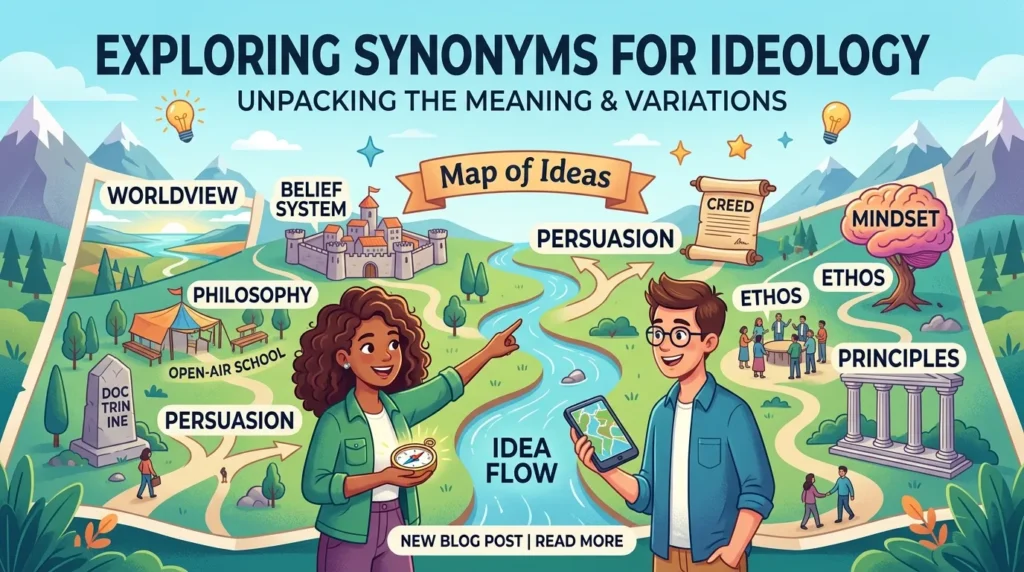
Knowing the synonyms for ideology is a game-changer. For students, it sharpens essay and debate skills. For content writers, it adds variety and authority. For daily English users, it makes opinions sound clearer and more confident. Whether you’re writing an article or having a discussion, these synonyms for ideology will help you express big ideas with precision and power.
1. Belief System
Meaning:
- A belief system is a set of ideas and values that a person or group lives by.
Examples:
- His belief system was shaped by years of travel and meeting people from different cultures.
- The company’s belief system was built around fairness, hard work, and transparency.
2. Doctrine
Meaning:
- A doctrine is a formal set of rules or principles taught by a religion, government, or organization.
Examples:
- The political party followed a doctrine that placed individual freedom above everything else.
- The school’s doctrine emphasized critical thinking over rote memorization.
3. Philosophy
Meaning:
- A philosophy is a deep set of ideas about life, truth, and how the world should work.
Examples:
- Her philosophy was simple: treat others the way you want to be treated.
- The startup’s philosophy was rooted in innovation and never accepting the status quo.
4. Worldview
Meaning:
- A worldview is the overall way a person sees and understands the world around them.
Examples:
- Growing up in a small town gave him a very different worldview from his city-raised colleagues.
- Her worldview shifted dramatically after volunteering abroad for a year.
5. Creed
Meaning:
- A creed is a short, strong statement of beliefs that guides a person’s or group’s actions.
Examples:
- The organization’s creed was posted on every wall: “Serve first, profit second.”
- He lived by a personal creed of honesty, no matter the cost.
6. Dogma
Meaning:
- Dogma is a fixed set of beliefs that a group insists are absolutely true and must not be questioned.
Examples:
- The cult’s dogma left no room for personal doubt or independent thinking.
- She challenged the political dogma of her party and caused quite a stir.
7. Ethos
Meaning:
- Ethos is the core character, spirit, and values that define a person, community, or culture.
Examples:
- The brand’s ethos was built around sustainability and reducing waste.
- The military school had an ethos of discipline, honor, and sacrifice.
8. Principles
Meaning:
- Principles are the basic rules or values that guide a person’s decisions and behavior.
Examples:
- She refused to compromise on her principles, even when it cost her the promotion.
- The organization was founded on principles of equality and human dignity.
9. Conviction
Meaning:
- A conviction is a strong, firm personal belief that someone holds deeply.
Examples:
- His conviction that education could change lives drove him to teach in underserved communities.
- She spoke with such conviction that no one dared argue back.
10. Credo
Meaning:
- A credo is a personal statement of core beliefs and values that someone commits to.
Examples:
- His credo was printed on a card he carried in his wallet every day.
- The team adopted a credo of “zero excuses, maximum effort” before every game.
11. Faith
Meaning:
- Faith is a deep trust or belief in something a religion, a cause, or a set of ideas.
Examples:
- Her faith in democratic values never wavered, even during the country’s darkest years.
- He placed his faith in science as the best path to human progress.
12. Thought System
Meaning:
- A thought system is an organized way of thinking about the world and its problems.
Examples:
- Marxism is a thought system that focuses on class struggle and economic equality.
- Her thought system was hard to pin down it blended science, spirituality, and common sense.
13. Mindset
Meaning:
- A mindset is a set of attitudes and assumptions that shape how a person thinks and acts.
Examples:
- A growth mindset means believing you can always improve with effort and learning.
- The company’s success came from a mindset that welcomed failure as part of the process.
14. Outlook
Meaning:
- An outlook is a person’s general attitude or perspective on life and the future.
Examples:
- Despite her struggles, she maintained a positive outlook on what tomorrow could bring.
- His outlook on politics was deeply shaped by what he saw growing up in poverty.
15. Stance
Meaning:
- A stance is the position or viewpoint a person or group takes on a particular issue.
Examples:
- The senator’s stance on climate change was clear and unwavering from day one.
- She took a firm stance against corruption, even within her own organization.
16. Persuasion
Meaning:
- In this context, persuasion refers to a particular school of thought or way of thinking.
Examples:
- He was of a conservative persuasion but respected views from across the spectrum.
- She described herself as being of a humanitarian persuasion when it came to policy.
17. Perspective
Meaning:
- A perspective is the particular angle or point of view from which someone sees an issue.
Examples:
- The documentary offered a fresh perspective on the refugee crisis that most news channels ignored.
- Learning history from multiple perspectives changes how you understand the present.
18. Value System
Meaning:
- A value system is the collection of personal or cultural values that guide decision-making.
Examples:
- Her value system placed family above career at every turning point in her life.
- The two leaders clashed because their value systems were fundamentally different.
19. Orthodoxy
Meaning:
- Orthodoxy is the accepted, official, or traditional set of beliefs held by a group.
Examples:
- The scientist challenged the orthodoxy of his field and sparked a major debate.
- Religious orthodoxy often resists change, even when society shifts around it.
20. Canon
Meaning:
- A canon is a body of accepted and authoritative rules, texts, or beliefs in a field or faith.
Examples:
- The Western literary canon has been criticized for excluding too many diverse voices.
- The political canon of liberalism evolved greatly throughout the twentieth century.
21. Tenet
Meaning:
- A tenet is one specific belief or principle within a larger system of ideas.
Examples:
- A core tenet of democracy is that every citizen deserves an equal vote.
- The movement was built on the tenet that all people deserve access to clean water.
22. Paradigm
Meaning:
- A paradigm is the dominant model or framework of thinking used in a particular field or era.
Examples:
- The internet caused a paradigm shift in how businesses connect with their customers.
- The old paradigm of “work hard and stay loyal” no longer fits the modern job market.
23. School of Thought
Meaning:
- A school of thought is a group of people who share the same set of ideas or approach.
Examples:
- There are two main schools of thought on how best to treat chronic pain.
- She belonged to a school of thought that believed in minimal government interference.
24. Moral Framework
Meaning:
- A moral framework is the structure of values and rules a person uses to judge right from wrong.
Examples:
- His moral framework was deeply influenced by his religious upbringing.
- Without a clear moral framework, decision-making in crises becomes very difficult.
25. Dogmatism
Meaning:
- Dogmatism is the tendency to hold one’s beliefs as absolute truth without allowing debate.
Examples:
- His dogmatism made any productive conversation about the policy impossible.
- The party’s dogmatism alienated younger voters who wanted nuanced discussions.
26. Ism
Meaning:
- An “ism” is an informal word for any system of beliefs or ideology ending in a specific suffix.
Examples:
- Capitalism, feminism, and nationalism are all forms of ism that shape modern society.
- She joked that she had her own ism: “realism with a side of optimism.”
27. Political Theory
Meaning:
- A political theory is a structured set of ideas about how governments and societies should work.
Examples:
- His political theory drew on both libertarianism and classical conservatism.
- Students of political theory study thinkers like Locke, Rousseau, and Marx.
28. Manifesto
Meaning:
- A manifesto is a public declaration of the beliefs, goals, and intentions of a group or movement.
Examples:
- The environmental group released a manifesto demanding action within ten years.
- His startup manifesto challenged every norm in the traditional business world.
29. Narrative
Meaning:
- A narrative is the story or framework used to explain and justify a set of beliefs.
Examples:
- The political party’s narrative focused heavily on national pride and economic strength.
- Changing the public narrative around mental health has taken decades of effort.
30. Vision
Meaning:
- A vision is the ideal future or end goal that an ideology or belief system works toward.
Examples:
- The leader’s vision for the country inspired millions who felt left behind by the system.
- Her vision of a more equal world drove every policy decision she made.
31. Platform
Meaning:
- A platform is the stated set of goals and beliefs a political party or movement, stands on.
Examples:
- The new party’s platform included free education, affordable housing, and green energy.
- She built her campaign platform around the needs of working-class families.
32. Theology
Meaning:
- Theology is the study of religious beliefs a structured ideology built around faith and God.
Examples:
- His theology rejected the idea that suffering was a punishment from God.
- She studied theology to better understand the belief systems of different world religions.
33. Metaphysics
Meaning:
- Metaphysics is the branch of philosophy dealing with deep questions about existence and reality.
Examples:
- His metaphysics led him to question whether the material world was all there really was.
- The professor’s metaphysics course challenged students to rethink everything they assumed was real.
34. Rationalism
Meaning:
- Rationalism is the ideology that reason and logic, not emotion or tradition, should guide decisions.
Examples:
- His rationalism meant he distrusted any policy not backed by strong data and evidence.
- Rationalism became the dominant ideology of the scientific revolution.
35. Humanism
Meaning:
- Humanism is an ideology centered on human dignity, reason, and welfare above religious doctrine.
Examples:
- Her humanism led her to support equal rights for all people regardless of background.
- Renaissance humanism placed human achievement and potential at the center of everything.
36. Collectivism
Meaning:
- Collectivism is the ideology that the group’s needs are more important than the individual’s.
Examples:
- The tribe operated on pure collectivism resources were shared equally among all members.
- Critics of collectivism argue that it can suppress individual creativity and ambition.
37. Individualism
Meaning:
- Individualism is the ideology that personal freedom and self-reliance are the highest values.
Examples:
- American culture is often described as deeply rooted in individualism.
- Her individualism made her reluctant to ask for help, even when she needed it most.
38. Radicalism
Meaning:
- Radicalism is the ideology that society needs complete, fundamental change not small reforms.
Examples:
- The movement’s radicalism frightened moderates who preferred slow, steady progress.
- His radicalism was born from decades of watching peaceful protests achieve nothing.
39. Conservatism
Meaning:
- Conservatism is the ideology that values tradition, stability, and resistance to rapid change.
Examples:
- Her conservatism was rooted in a deep respect for cultural heritage and family values.
- Fiscal conservatism emphasizes keeping government spending as low as possible.
40. Liberalism
Meaning:
- Liberalism is the ideology that champions individual rights, equality, and progressive reform.
Examples:
- Classical liberalism placed personal freedom at the center of every political decision.
- Her liberalism drove her to advocate for healthcare access for every citizen.
41. Pragmatism
Meaning:
- Pragmatism is the ideology that practical results matter more than rigid principles or theories.
Examples:
- His pragmatism meant he was willing to work with anyone who could get the job done.
- Pragmatism in politics often means compromising ideals to pass workable laws.
42. Utopianism
Meaning:
- Utopianism is the ideology built around the belief in a perfect, ideal society.
Examples:
- His utopianism was inspiring, but critics said his plans were impossible to implement.
- Early socialist movements were often rooted in a form of utopianism that imagined total equality.
43. Fundamentalism
Meaning:
- Fundamentalism is a strict, literal adherence to a core set of beliefs with no room for flexibility.
Examples:
- Religious fundamentalism often resists any reinterpretation of sacred texts.
- Political fundamentalism can make compromise between opposing parties nearly impossible.
44. Revisionism
Meaning:
- Revisionism is the ideology of reinterpreting or updating established beliefs or historical accounts.
Examples:
- Historical revisionism can be healthy when it corrects biased or incomplete narratives.
- The old guard accused the new leaders of dangerous revisionism for updating party policy.
45. Sectarianism
Meaning:
- Sectarianism is a narrow, exclusive ideology that favors one group and rejects all others.
Examples:
- Sectarianism tore the community apart when neighbors who had lived together peacefully began to choose sides.
- The party’s sectarianism cost it the support of voters who wanted unity over division.
46. Activism
Meaning:
- Activism is an ideology driven by the commitment to create change through direct action.
Examples:
- Her activism began the day she saw her neighborhood school close due to a lack of funding.
- Environmental activism has moved from the fringe to the mainstream in just one generation.
47. Positivism
Meaning:
- Positivism is the ideology that only scientifically verifiable facts form the basis of true knowledge.
Examples:
- His positivism meant he dismissed any idea that couldn’t be tested and measured.
- Positivism transformed the social sciences by demanding evidence for every claim.
48. Progressivism
Meaning:
- Progressivism is the ideology that society should continuously move forward toward greater equality and justice.
Examples:
- Her progressivism pushed her to fight for policies that the previous generation thought impossible.
- Progressivism in education means continuously questioning what is taught and how it is taught.
49. Nationalism
Meaning:
- Nationalism is the ideology that promotes strong loyalty to and pride in one’s nation above all else.
Examples:
- Economic nationalism drives many countries to protect local industries from foreign competition.
- Cultural nationalism celebrates a country’s unique history, language, and traditions.
50. Secularism
Meaning:
- Secularism is the ideology that religion and government should be kept completely separate.
Examples:
- Secularism ensures that laws apply equally to citizens of all faiths and none.
- She championed secularism as the only fair foundation for a diverse, modern democracy.
Conclusion
Knowing the synonyms for ideology transforms the way you write, speak, and think. These words let you name big ideas clearly and confidently, whether you’re crafting a blog post, debating a topic in class, or writing a professional email. A broader vocabulary signals deeper thinking. Pick one or two of these words today and use them in a sentence. Then try another tomorrow. Small steps build big language skills, and big language skills open big doors.