Have you ever noticed how two people say the same thing, but one sounds clearer and more beautiful? That is because of their diction.
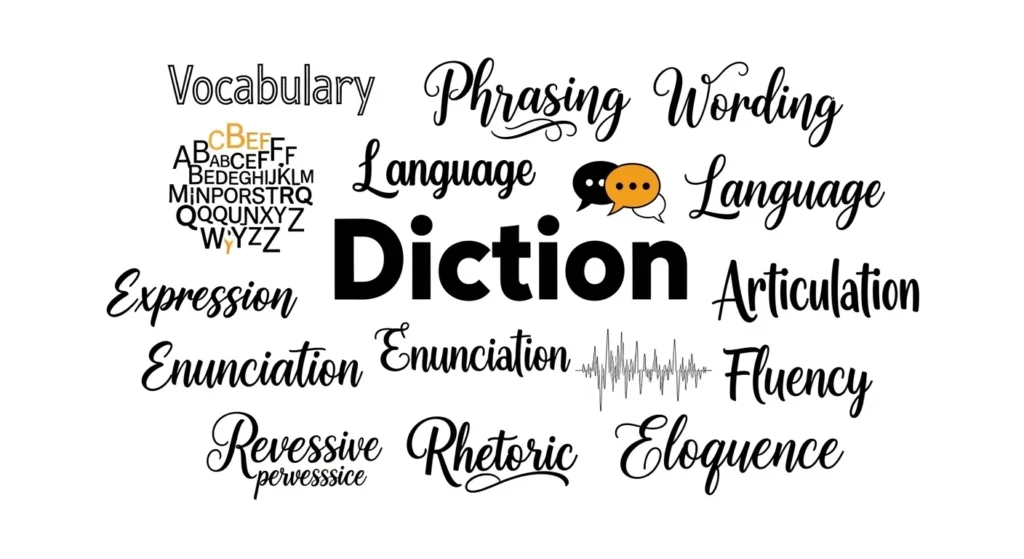
In very simple words, diction means “the way we choose and use words when we speak or write.” It shows how clear, simple, or powerful our language is. For example, a teacher with good diction speaks clearly. A writer with good diction chooses the right words.
Imagine you are writing an essay. If you use simple and correct words, your diction is good. If your words are confusing, your diction is not clear.
This word is very important for students, bloggers, and content writers. Good diction helps students get better marks. Bloggers use it to connect with readers. Writers use it to make their content strong and easy to read.
Learning will help you express ideas in many ways. It will make your writing more interesting and your speech more confident.
MAIN CONTENT – SYNONYMS LIST
Word choice
Meaning: The words someone selects.
Examples:
- Her word choice is simple.
- Good word choice helps writing.
Vocabulary
Meaning: All the words someone knows.
Examples:
- His vocabulary is strong.
- I improve my vocabulary daily.
Language
Meaning: The system of words we use.
Examples:
- She uses simple language.
- This language is easy.
Speech
Meaning: The way someone speaks.
Examples:
- His speech is clear.
- She gave a speech.
Expression
Meaning: The way ideas are shared.
Examples:
- Her expression is nice.
- He showed expression.
Phrasing
Meaning: The way words are arranged.
Examples:
- I like your phrasing.
- Her phrasing is neat.
Style
Meaning: A special way of using words.
Examples:
- His style is unique.
- She has good style.
Wording
Meaning: The way something is written.
Examples:
- The wording is clear.
- I changed the wording.
Terminology
Meaning: Special words for a subject.
Examples:
- Learn the terminology.
- This field has hard terminology.
Usage
Meaning: The way words are used.
Examples:
- Correct usage matters.
- He studies usage.
Articulation
Meaning: Clear speaking of words.
Examples:
- Her articulation is good.
- He practices articulation.
Enunciation
Meaning: Speaking words clearly.
Examples:
- Good enunciation helps.
- She has clear enunciation.
Pronunciation
Meaning: The way words are spoken.
Examples:
- His pronunciation is right.
- Practice pronunciation daily.
Delivery
Meaning: The way speech is given.
Examples:
- His delivery is smooth.
- She improved her delivery.
Voice
Meaning: The sound of speech.
Examples:
- Her voice is soft.
- He raised his voice.
Tone
Meaning: The feeling in speech.
Examples:
- His tone is kind.
- Use a polite tone.
Register
Meaning: Level of formality in language.
Examples:
- Use formal register.
- His register is casual.
Lexicon
Meaning: A set of words.
Examples:
- His lexicon is wide.
- Learn new lexical words.
Word use
Meaning: How words are used.
Examples:
- Word use matters.
- Improve your word use.
Word selection
Meaning: Choosing words carefully.
Examples:
- Good word selection helps.
- She improved word selection.
Mode of speech
Meaning: Way of speaking.
Examples:
- His mode of speech is calm.
- Change your mode of speech.
Verbal style
Meaning: Style of speaking.
Examples:
- I like his verbal style.
- Her verbal style is clear.
Writing style
Meaning: Style used in writing.
Examples:
- His writing style is simple.
- She improved her writing style.
Language use
Meaning: How language is used.
Examples:
- Good language use matters.
- She studies language use.
Choice of words
Meaning: Selection of words.
Examples:
- His choice of words is strong.
- Improve your choice of words.
Verbiage
Meaning: Use of many words.
Examples:
- Avoid too much verbiage.
- His verbiage is long.
Eloquence
Meaning: Fluent and strong speech.
Examples:
- Her eloquence impressed me.
- He speaks with eloquence.
Fluency
Meaning: Smooth and easy speech.
Examples:
- She has fluency.
- Practice improves fluency.
Expression style
Meaning: Way of expressing ideas.
Examples:
- His expression style is good.
- She changed her expression style.
Word pattern
Meaning: Pattern of words used.
Examples:
- Notice the word pattern.
- His word pattern is simple.
Communication style
Meaning: Way of sharing ideas.
Examples:
- Her communication style is clear.
- Improve communication style.
Speaking style
Meaning: Way of speaking.
Examples:
- His speaking style is calm.
- She has a clear speaking style.
Writing expression
Meaning: Way of writing ideas.
Examples:
- His writing expression is strong.
- She improved her writing expression.
Verbal expression
Meaning: Spoken way of sharing ideas.
Examples:
- His verbal expression is good.
- She works on verbal expression.
Linguistic style
Meaning: Style of language use.
Examples:
- His linguistic style is unique.
- Study linguistic style.
Language pattern
Meaning: Pattern in language use.
Examples:
- The language pattern is simple.
- I like this language pattern.
Speech pattern
Meaning: Pattern of speaking.
Examples:
- His speech pattern is slow.
- She changed her speech pattern.
Clarity
Meaning: Being easy to understand.
Examples:
- Clarity is important.
- Her clarity is great.
Precision
Meaning: Being exact and correct.
Examples:
- Use precision in words.
- His precision is strong.
Accuracy
Meaning: Being correct.
Examples:
- Accuracy matters.
- Check for accuracy.
Simplicity
Meaning: Being easy and clear.
Examples:
- Simplicity helps readers.
- I like simplicity.
Formality
Meaning: Being formal in speech.
Examples:
- Use formality here.
- His formality is high.
Informality
Meaning: Casual way of speaking.
Examples:
- Informality is fine here.
- His informality is friendly.
Word clarity
Meaning: Clear use of words.
Examples:
- Word clarity is key.
- Improve word clarity.
Language clarity
Meaning: Clear language use.
Examples:
- Language clarity matters.
- She has language clarity.
Verbal clarity
Meaning: Clear speaking.
Examples:
- Verbal clarity helps.
- He improved verbal clarity.
Writing clarity
Meaning: Clear writing.
Examples:
- Writing clarity is good.
- She works on writing clarity.
Speech clarity
Meaning: Clear speech.
Examples:
- Speech clarity matters.
- He has speech clarity.
Expression clarity
Meaning: Clear expression.
Examples:
- Expression clarity is key.
- She improved expression clarity.
Word flow
Meaning: Smooth flow of words.
Examples:
- Word flow is smooth.
- Improve your word flow.
Language flow
Meaning: Smooth language use.
Examples:
- Language flow is good.
- His language flow improved.
Speech flow
Meaning: Smooth speaking.
Examples:
- Speech flow matters.
- She has good speech flow.
Writing flow
Meaning: Smooth writing.
Examples:
- Writing flow is nice.
- Improve writing flow.
Expression flow
Meaning: Smooth expression.
Examples:
- Expression flow helps.
- He improved expression flow.
Word form
Meaning: Form of words used.
Examples:
- Check word form.
- His word form is correct.
Language form
Meaning: Structure of language.
Examples:
- Language form is simple.
- Study language form.
Speech form
Meaning: Form of speaking.
Examples:
- Speech form is clear.
- Change speech form.
Writing form
Meaning: Form of writing.
Examples:
- Writing form matters.
- Improve writing form.
Expression form
Meaning: Form of expression.
Examples:
- The expression form is good.
- She changed her expression.
CONCLUSION
Learning synonyms for diction can greatly improve your English skills. When you understand different ways to describe how words are used, your writing and speaking become clearer and more powerful.
Good diction means choosing the right words at the right time. When you practice these synonyms, you start to notice how language works. You also become more aware of how you speak and write.
Try to use these words in your daily life. Write better emails, improve your essays, and speak with more confidence. Start with simple words like vocabulary, word choice, and expression, then slowly use more advanced ones.
Keep practicing every day. Over time, your diction will improve, and your English will sound natural, clear, and strong.