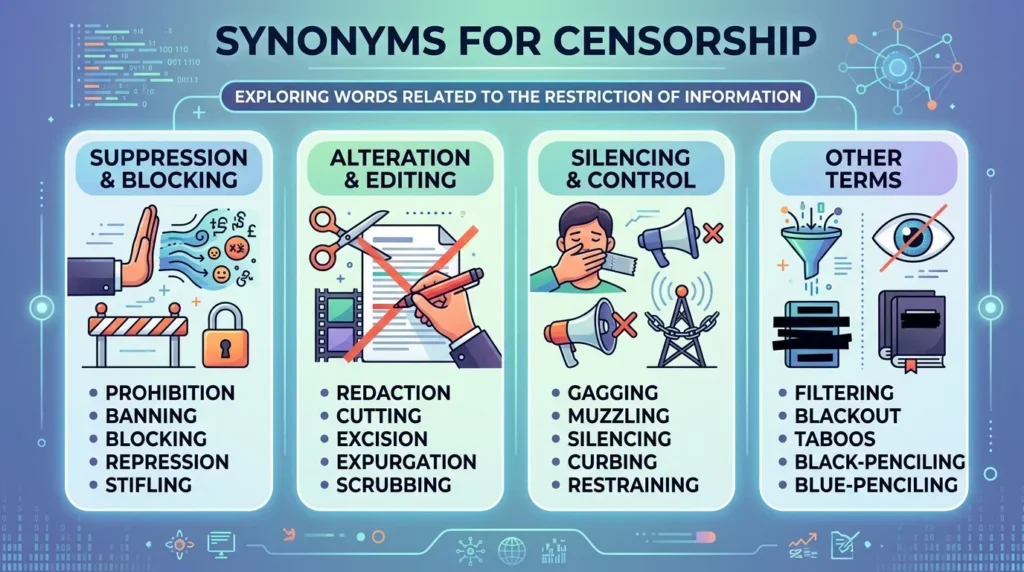
Have you ever seen a video removed from the internet or a book blocked in school? That is often called censorship. It happens when someone controls what people can read, watch, hear, or share.
The phrase “synonyms for censorship” helps people learn different words related to control, restriction, and limiting information. For example, instead of saying “censorship,” you may use words like “suppression” or “restriction.”
Learning synonyms for censorship is useful for students, bloggers, writers, and daily English users. These words can improve essays, articles, debates, and conversations. They also help writers avoid repeating the same word many times.
In this guide, you will learn simple synonyms for censorship, along with easy definitions and real-life examples.
Suppression
Meaning:
Stopping something from being shared or shown.
Examples:
- The news faced suppression online.
- People protested against suppression yesterday.
Restriction
Meaning:
A rule that limits something.
Examples:
- The school added restrictions on phones.
- Travel restrictions started last week.
Control
Meaning:
The power to manage or limit something.
Examples:
- The government increased media control.
- Parents control screen time at home.
Ban
Meaning:
An official rule that stops something.
Examples:
- The city placed a ban on smoking.
- The book ban upset many students.
Limitation
Meaning:
Something that reduces freedom or choice.
Examples:
- The website has age limitations.
- New limitations affected the workers.
Regulation
Meaning:
An official rule for managing something.
Examples:
- New regulations changed internet use.
- The company followed safety regulations.
Screening
Meaning:
Checking content before showing it.
Examples:
- Movies go through a screening first.
- The article passed media screening.
Filtering
Meaning:
Removing unwanted information.
Examples:
- The app uses content filtering.
- Schools use filtering on computers.
Blackout
Meaning:
A stop on sharing information.
Examples:
- The news blackout lasted two days.
- Internet blackout affected the town.
Silencing
Meaning:
Stopping people from speaking.
Examples:
- Many people opposed public silencing.
- The rule caused online silencing.
Blocking
Meaning:
Preventing access to something.
Examples:
- The site started blocking harmful pages.
- Parents use blocking tools online.
Editing
Meaning:
Changing content before people see it.
Examples:
- The speech needed careful editing.
- Editors finished editing the article.
Redaction
Meaning:
Removing private or sensitive parts.
Examples:
- The file included heavy redaction.
- Officials used redaction on reports.
Monitoring
Meaning:
Watching something closely.
Examples:
- The company increased internet monitoring.
- Teachers use monitoring during exams.
Supervision
Meaning:
Watching and controlling activities.
Examples:
- Children need supervision online.
- The project worked under supervision.
Oversight
Meaning:
Careful watching or checking.
Examples:
- Government oversight increased this year.
- The program works with strict oversight.
Restraint
Meaning:
Holding back or limiting something.
Examples:
- The report showed media restraint.
- She spoke with emotional restraint.
Clampdown
Meaning:
Strong action to stop something.
Examples:
- The city began a media clampdown.
- Officials announced a strict clampdown.
Gagging
Meaning:
Stopping someone from speaking freely.
Examples:
- Reporters complained about public gagging.
- The rule felt like gagging.
Muzzling
Meaning:
Preventing someone from speaking openly.
Examples:
- Critics called it media muzzling.
- Workers feared public muzzling.
Suppressing
Meaning:
Keeping something from being known.
Examples:
- The group was accused of suppressing facts.
- She disliked suppressing her opinions.
Constraint
Meaning:
Something that limits freedom.
Examples:
- Financial constraints hurt the project.
- New constraints affected speech online.
Interference
Meaning:
Getting involved to control something.
Examples:
- People disliked government interference.
- The teacher stopped outside interference.
Intervention
Meaning:
Action taken to control a situation.
Examples:
- Officials made an intervention quickly.
- Parent intervention solved the problem.
Regulation
Meaning:
Rules used to manage activities.
Examples:
- Internet regulation became stricter.
- The office follows company regulations.
Policing
Meaning:
Controlling behavior through rules.
Examples:
- Social media policing has increased recently.
- Students disliked strict policing online.
Watchdogging
Meaning:
Carefully checking for problems.
Examples:
- The group focused on watchdogging media.
- Watchdogging protects online users.
Checking
Meaning:
Looking at something carefully.
Examples:
- The article needed fact-checking.
- Teachers are checking student work.
Moderation
Meaning:
Controlling harmful or unfair content.
Examples:
- The app improved comment moderation.
- Moderation keeps forums safe.
Exclusion
Meaning:
Keeping something out.
Examples:
- The rule caused information exclusion.
- Exclusion upset many readers.
Removal
Meaning:
Taking something away.
Examples:
- The video faced sudden removal.
- Removal of posts angered users.
Deletion
Meaning:
Erasing something.
Examples:
- The message disappeared after deletion.
- Photo deletion shocked many fans.
Cancellation
Meaning:
Stopping something from continuing.
Examples:
- The event faced cancellation yesterday.
- The show cancellation disappointed viewers.
Erasure
Meaning:
Removing something from records or memory.
Examples:
- The book described cultural erasure.
- Online erasure worried many people.
Prevention
Meaning:
Stopping something before it happens.
Examples:
- Prevention rules blocked harmful posts.
- Good filters help prevent online.
Inhibition
Meaning:
Holding back actions or speech.
Examples:
- Fear caused speech inhibition.
- Inhibition stopped open discussion.
Obstruction
Meaning:
Blocking progress or access.
Examples:
- Protesters complained about information obstruction.
- Road obstruction delayed traffic badly.
Interruption
Meaning:
Stopping something for a short time.
Examples:
- Internet interruption affected students.
- The speech faced constant interruption.
Confinement
Meaning:
Keeping something within limits.
Examples:
- The rules created creative confinement.
- Confinement reduced open discussion.
Tightening
Meaning:
Making rules stricter.
Examples:
- The government announced media tightening.
- Tightening rules changed online content.
Pressure
Meaning:
Force used to influence actions.
Examples:
- Reporters felt political pressure.
- Family pressure changed his decision.
Intimidation
Meaning:
Using fear to control people.
Examples:
- Journalists reported online intimidation.
- Bullying is a form of intimidation.
Repression
Meaning:
Strong control over freedom.
Examples:
- Citizens protested against repression.
- Repression limited free speech badly.
Shutdown
Meaning:
A complete stop of activity.
Examples:
- The website faced a shutdown.
- Internet shutdown hurt businesses.
Containment
Meaning:
Keeping something under control.
Examples:
- Officials focused on rumor containment.
- Fire containment saved nearby homes.
Secrecy
Meaning:
Keeping information hidden.
Examples:
- Government secrecy caused concern.
- The plan remained under secrecy.
Confidentiality
Meaning:
Keeping information private.
Examples:
- Doctors follow patient confidentiality.
- Confidentiality protects personal records.
Concealment
Meaning:
Hiding something from others.
Examples:
- The story involved document concealment.
- Concealment created public suspicion.
Hushing
Meaning:
Making someone stay quiet.
Examples:
- Fans accused the group of hushing critics.
- Hushing children solved nothing.
Quieting
Meaning:
Reducing noise or public discussion.
Examples:
- Officials focused on quieting rumors.
- Quieting complaints took time.
Restricting
Meaning:
Limiting access or freedom.
Examples:
- The app started restricting comments.
- Restricting phones helped students focus.
Conclusion
Learning synonyms for censorship can improve writing, speaking, and communication skills. These words help students, bloggers, and writers explain ideas more clearly and naturally. They also make essays and articles more powerful and less repetitive.
Practice these synonyms in emails, school assignments, and daily conversations. The more vocabulary you learn, the better your English becomes.