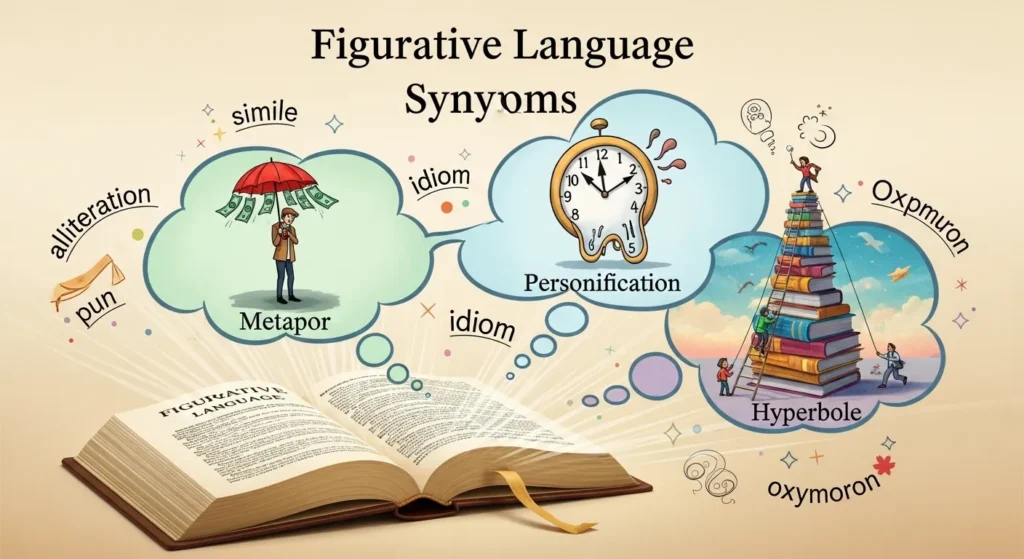
Have you ever heard someone say, “Time is flying”? Time does not really fly, but the sentence helps us imagine how fast time passes. This type of expression is called figurative language.
Figurative language means using words in a creative or non-literal way to make ideas more colorful and interesting. Writers, poets, and speakers use it to paint pictures in the reader’s mind.
Learning figurative language synonyms helps students understand literature better. It also helps bloggers, content writers, and everyday English users write more vivid and engaging sentences. Instead of plain words, figurative expressions make language lively and memorable.
Below are 50 figurative language synonyms and related terms with simple meanings and examples.
Metaphorical Language
Meaning: Words used to describe something by comparing it to another thing.
Examples:
- Her voice was a soft melody.
- The classroom became a zoo.
Symbolic Language
Meaning: Words that represent deeper ideas.
Examples:
- The dove symbolized peace.
- The crown symbolized power.
Descriptive Language
Meaning: Words that help create strong images.
Examples:
- The sky looked like orange fire.
- The lake shined like glass.
Poetic Language
Meaning: Beautiful and creative language often used in poetry.
Examples:
- The poet used poetic language.
- Her speech sounded poetic.
Imaginative Language
Meaning: Language that uses imagination.
Examples:
- The story used imaginative language.
- Children enjoy imaginative words.
Nonliteral Language
Meaning: Words that are not meant to be taken literally.
Examples:
- “Break a leg” is nonliteral language.
- The phrase confused the student.
Figurative Expression
Meaning: A phrase that creates a picture in the mind.
Examples:
- “Heart of stone” is a figurative expression.
- The book uses many figurative expressions.
Literary Language
Meaning: Language used in stories and literature.
Examples:
- The novel uses literary language.
- Students study literary language.
Colorful Language
Meaning: Language that is lively and interesting.
Examples:
- The writer used colorful language.
- The story felt exciting.
Creative Language
Meaning: Words used uniquely and artistically.
Examples:
- The poem uses creative language.
- Her speech was creative.
Expressive Language
Meaning: Language that shows feelings strongly.
Examples:
- The poem uses expressive language.
- His words were expressive.
Imagery
Meaning: Words that help readers see pictures in their mind.
Examples:
- The poem is full of imagery.
- The writer describes a golden sunset.
Allegorical Language
Meaning: Language that tells a story with a hidden meaning.
Examples:
- The story uses allegorical language.
- The animals represent people.
Symbolism
Meaning: Using objects or ideas to represent something else.
Examples:
- The red rose shows love.
- The storm symbolizes trouble.
Metaphor
Meaning: A comparison saying one thing is another.
Examples:
- The world is a stage.
- Time is money.
Simile
Meaning: A comparison using “like” or “as”.
Examples:
- She runs like the wind.
- He is as brave as a lion.
Hyperbole
Meaning: An extreme exaggeration.
Examples:
- I waited forever.
- This bag weighs a ton.
Personification
Meaning: Giving human qualities to things.
Examples:
- The wind whispered.
- The sun smiled.
Idiomatic Language
Meaning: Phrases with special meanings.
Examples:
- He kicked the bucket.
- She hit the books.
Figurative Speech
Meaning: Speaking with creative comparisons.
Examples:
- The teacher explained figurative speech.
- The poem uses figurative speech.
Ornamental Language
Meaning: Words used to decorate writing.
Examples:
- The speech used ornamental language.
- The poem sounded elegant.
Artistic Language
Meaning: Language that sounds creative and beautiful.
Examples:
- The author used artistic language.
- Her poem felt artistic.
Decorative Language
Meaning: Words added to make writing more interesting.
Examples:
- The story uses decorative language.
- The description felt lively.
Dramatic Language
Meaning: Language that creates strong emotion.
Examples:
- The speech used dramatic language.
- The play sounded powerful.
Vivid Language
Meaning: Language that creates clear mental pictures.
Examples:
- The book uses vivid language.
- The scene felt real.
Emotional Language
Meaning: Words that express strong feelings.
Examples:
- The poem uses emotional language.
- The speech moved the audience.
Sensory Language
Meaning: Words that describe sights, sounds, or smells.
Examples:
- The author uses sensory language.
- The story describes sweet smells.
Storytelling Language
Meaning: Words used to make stories interesting.
Examples:
- The writer uses storytelling language.
- Children enjoy storytelling words.
Narrative Language
Meaning: Language used to tell a story.
Examples:
- The book uses narrative language.
- The teacher explained narrative language.
Descriptive Imagery
Meaning: Words that create strong pictures.
Examples:
- The poem uses descriptive imagery.
- The sunset description was vivid.
Metaphorical Expression
Meaning: A phrase using a metaphor.
Examples:
- “Iron will” is a metaphorical expression.
- The writer used a metaphorical expression.
Figurative Description
Meaning: Description using imaginative comparisons.
Examples:
- The story uses figurative description.
- The hero was called a lion.
Artistic Expression
Meaning: Creative use of language.
Examples:
- Poetry is an artistic expression.
- The speech felt expressive.
Literary Device
Meaning: A technique writers use in literature.
Examples:
- Metaphor is a literary device.
- Students learn literary devices.
Stylistic Language
Meaning: Language used to create style.
Examples:
- The writer uses stylistic language.
- The essay shows strong style.
Expressive Writing
Meaning: Writing that shows feelings.
Examples:
- The poem is expressive writing.
- She enjoys expressive writing.
Creative Expression
Meaning: Sharing ideas through creative words.
Examples:
- Poetry allows creative expression.
- Students enjoy creative expression.
Symbolic Expression
Meaning: Words that represent deeper ideas.
Examples:
- The story uses symbolic expression.
- The flag symbolizes freedom.
Visual Language
Meaning: Words that help readers imagine scenes.
Examples:
- The author uses visual language.
- The description shows a bright beach.
Poetic Expression
Meaning: Creative language like poetry.
Examples:
- The speech had poetic expression.
- The poem uses poetic expression.
Imaginative Expression
Meaning: Creative and thoughtful wording.
Examples:
- The book uses imaginative expression.
- Children love imaginative expression.
Figurative Writing
Meaning: Writing that uses comparisons and imagery.
Examples:
- The story uses figurative writing.
- The poem shows figurative writing.
Literary Expression
Meaning: Language used in literature.
Examples:
- The novel uses literary expression.
- The essay has literary expression.
Emotional Expression
Meaning: Words showing strong feelings.
Examples:
- The poem shows emotional expression.
- The speech shows emotional expression.
Creative Description
Meaning: Imaginatively describing things.
Examples:
- The author used creative description.
- The forest felt magical.
Descriptive Expression
Meaning: Language that explains with images.
Examples:
- The essay uses descriptive language.
- The teacher praised the description.
Figurative Comparison
Meaning: Comparing things creatively.
Examples:
- The poem uses figurative comparison.
- The hero was compared to a lion.
Poetic Imagery
Meaning: Strong images created in poetry.
Examples:
- The poem uses poetic imagery.
- The words paint a sunset.
Literary Imagery
Meaning: Imagery used in literature.
Examples:
- The novel uses literary imagery.
- Students studied literary imagery.
Symbolic Writing
Meaning: Writing that uses symbols.
Examples:
- The story uses symbolic writing.
- The crown shows power.
Figurative Style
Meaning: A writing style that uses figurative language.
Examples:
- The author writes in a figurative style.
- The poem shows a figurative style.
Conclusion
Learning figurative language synonyms helps you understand literature and creative writing better. These words allow writers to express ideas in vivid and imaginative ways.
Students, bloggers, and writers can use these expressions to make stories, essays, and conversations more engaging. Practice using them in daily writing, and your language will become richer and more expressive.